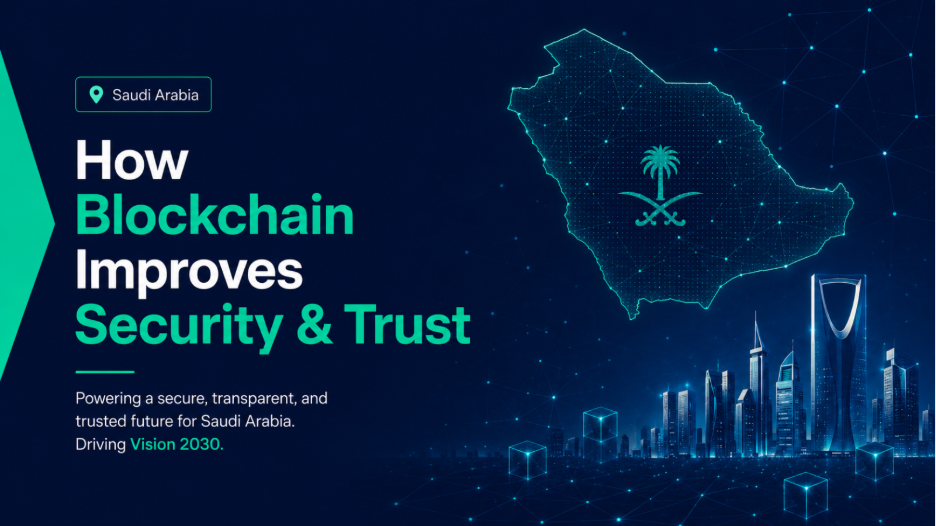
Trust is the currency of every digital economy. Vision 2030 is driving rapid digital transformation across Saudi Arabia’s key sectors. This makes accurate, secure, and trusted data more important than ever. Middle East data breaches averaged USD 8.75 million in 2024. This remains among the highest breach costs worldwide. Saudi business leaders now expect security beyond firewalls and audit logs.
Blockchain development services offer a stronger approach to data security and trust. Blockchain protects records and confirms identities using cryptography and shared validation. It also reduces fraud by removing reliance on a single point of trust. This article explains how blockchain improves security and protects business data. It also covers what Saudi organisations should seek in a blockchain partner.
What Are Blockchain Development Services?
Blockchain development services cover the full lifecycle of blockchain applications. It covers smart contracts, wallets, tokens, nodes, and security. It also connects blockchain with ERP, CRM, and core banking systems.
An experienced blockchain development company usually handles these services. It brings together secure technology, development skills, and industry expertise.
Offerings often include:
- Custom blockchain solutions built for private, public, or hybrid networks.
- Blockchain solutions are built for regulated industries.
- Secure blockchain development services with formal audits and penetration testing.
- Blockchain development consulting services for strategy, use case selection, and governance.
Decision-makers now seek production-ready blockchain solutions. They must also meet local rules such as PDPL and SAMA requirements.
How Does Blockchain Improve Security?
Traditional systems keep data centrally and rely on perimeter security. A breach can expose records to hidden changes or deletion. Blockchain flips that model. Data is stored in linked, encrypted blocks across multiple nodes. Changes to a block disrupt the chain and are rejected by the network.
Three properties do most of the heavy lifting:
Immutability:
Confirmed transactions remain permanent and tamper-resistant.
Decentralisation:
No single server holds the only copy.
Consensus:
Nodes validate ledger updates through shared consensus rules. These methods are well suited to enterprise blockchain networks.
Key Security Features of Blockchain Technology Services
Blockchain Encryption
Each blockchain transaction is signed and hashed using strong cryptography. Encryption keeps intercepted blockchain data unreadable to unauthorised users. Only the correct keys can alter it. This protection meets security needs in banking, energy, and healthcare.
Blockchain Authentication
Blockchain authentication uses public and private keys rather than shared passwords. Each user or device has a unique identity that can be verified mathematically. This approach limits phishing, credential theft, and insider threats.
Blockchain Access Control
Permissioned networks use access controls to manage who can read, write, or validate transactions. Smart contracts automatically enforce access rules and approvals. This reduces manual steps that can be missed or bypassed.
Distributed Ledger Technology
Distributed ledger technology spreads the same data across many nodes. If one node is compromised or offline, the network keeps working. This feature supports critical infrastructure and international trade. It also supports Hajj and Umrah logistics where downtime is costly.
Traditional Systems vs Blockchain Solutions: A Quick Comparison
The table below summarises how blockchain solutions strengthen security compared with typical centralised systems still used across many enterprises.
| Security Factor | Traditional Systems | Blockchain Solutions |
| Data Storage | Central servers, single point of failure | Distributed across a network of nodes |
| Tampering Risk | Records can be altered by insiders | Cryptographic hashing makes tampering visible |
| Authentication | Passwords and shared credentials | Public and private key pairs |
| Audit Trail | Editable logs, gaps possible | Immutable, time-stamped ledger |
| Downtime Risk | Outage if the central system fails | Network keeps running if some nodes fail |
| Trust Model | Requires trust in a single operator | Trust distributed through consensus |
How Does Blockchain Protect Business Data?
Blockchain protects business data in four practical ways. It provides a permanent record of every transaction and activity. It reduces manual reconciliations, lowering errors and fraud. Smart contracts automatically execute agreed rules. Payments or access only trigger when set conditions are met. Sensitive data can stay off-chain for greater privacy. Blockchain records can still verify their existence and integrity.
Grand View Research projects the blockchain market to reach USD 1.43 trillion by 2030. It is expected to grow at an annual rate above 87 percent. PwC forecasts blockchain could contribute more than USD 15 billion to GCC economies by 2030. Financial services, logistics, and public administration are leading adoption.
How Can Blockchain Development Services Rectify Business Security?
Saudi Arabia is investing heavily in digital infrastructure under Vision 2030. NCA and SDAIA are also driving this digital push. Blockchain development services for businesses in the Kingdom are being applied to:
- Trade finance and credit processing through Jeddah and King Abdulaziz ports.
- Land records, notarisation, and property transfers managed by government bodies.
- Halal certification and food traceability across supply chains.
- Digital identity for citizens and residents in line with SDAIA guidance.
- Sukuk issuance, settlement, and tokenised assets under SAMA and CMA oversight.
An experienced blockchain provider strengthens governance and key security. It also supports compliance with PDPL and Essential Cybersecurity Controls.
What Are the Security Benefits of Blockchain Technology?
Business leaders focus less on the technology itself and more on the results it delivers. The security benefits of blockchain technology that resonate most in enterprise settings include:
- Lower fraud risk through tamper-evident records.
- Faster and cleaner audits, reducing compliance costs.
- Stronger identity assurance for staff, partners, and customers.
- Better resilience against malware and single-point failures.
- Clear provenance for goods, documents, and digital assets.
Choosing the Right Blockchain Development Company
Not every vendor offering blockchain services can support a regulated Saudi enterprise. When evaluating partners, look for:
- Proven blockchain experience across banking, government, or supply chains.
- Strong skills in smart contracts, key security, and consensus.
- Experience connecting blockchain with ERP, banking, and identity systems.
- Proven experience delivering audited, secure blockchain solutions.
- Local understanding of Arabic language needs, PDPL, SAMA rules, and Vision 2030 priorities.
Aiimone helps Saudi enterprises plan, build, and secure blockchain platforms. It combines consulting with hands-on blockchain engineering.
Final Thoughts
Security and trust are no longer back-office concerns. They influence customer trust and regulatory approval. They also shape Saudi enterprises’ global competitiveness. Blockchain services improve security and trust through encryption and shared ledgers. They also combine authentication and access control in one system. The organisations that move now will set the standard for how business is done across the Kingdom for the next decade.