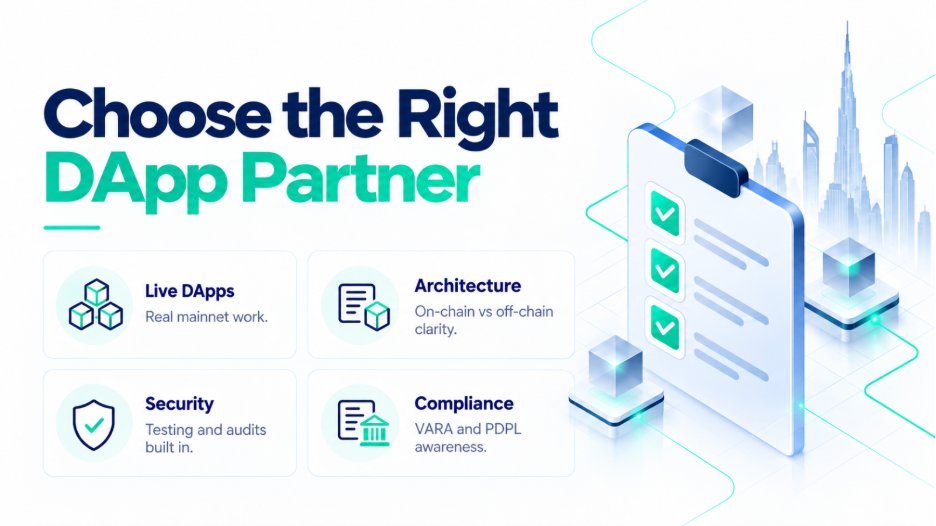
To choose the right dapp development company, check five things: a record of live decentralised apps you can verify, real depth in blockchain architecture, security testing built into every release, working knowledge of UAE rules such as VARA and the PDPL, and clear support after launch. A firm that is weak on any one of these adds risk your project can’t afford.
Dubai has spent the last few years building the rules, licences, and infrastructure that serious blockchain projects need. The question for most boards is no longer whether to build. It’s who should build it.
A decentralised app (DApp) handles money, identity, or ownership records through code that can’t be quietly patched after launch. One flawed contract can drain a treasury in minutes. One poor platform choice can lock your users into fees and speeds that don’t fit the product.
That’s why choosing a dapp development company is a strategic decision, not a procurement checkbox. This guide sets out the criteria, the numbers, and the questions Dubai founders and enterprise leaders can use to find the best DApp development company for blockchain projects.
Why Dubai Is a Serious Market for DApp Development in 2026?
The numbers explain urgency. Industry estimates put the global DApp market at USD 30 billion in 2024, with a forecast of USD 70.82 billion by 2030 at a CAGR of about 18.7%. The narrower market for DApp development services, meaning the work of designing and building these apps, is projected to rise from USD 4.11 billion in 2025 to roughly USD 22 billion by 2035.
The UAE is capturing a large share of that activity. Regional reporting suggests that about 1 in 4 UAE adults hold digital assets, with more than USD 30 billion in crypto inflows over a single 12-month period.
Regulation has matured alongside adoption:
- VARA, created under Dubai Law No. 4 of 2022, licenses and supervises virtual asset activity in the emirate.
- Five regulators now oversee virtual asset providers in the UAE: VARA, DFSA in DIFC, FSRA in ADGM, the Central Bank of the UAE, and the federal Capital Market Authority.
- The Central Bank of the UAE approved the AED-backed DDSC stablecoin in February 2026.
- A Dubai tokenised property pilot, which ran from May 2025 to February 2026, channelled more than AED 18.5 million into tokenised real estate.
These steps support the Dubai Economic Agenda D33 and its goal of a leading digital economy. For anyone planning Web3 development in the emirate, the message is clear. Users and regulators now expect production-ready apps, not experiments.
How Do I Choose the Right DApp Development Company?
Start with evidence, not pitch decks. The six criteria below separate a capable blockchain development company from one that has only built demos.
A Portfolio of Live, Audited DApps
Ask for contract addresses you can check on a public block explorer, not just screenshots. Live apps show whether a team has handled real users, real transaction fees, and real incidents. Check how many projects reached mainnet and how many are still running.
Strong DApp developers will also walk you through a problem they fixed after launch. That answer tells you more than any polished case study.
Depth in Blockchain Architecture and Protocol Development
Good Web3 application development starts well before anyone writes code. The team should explain how they’ll split logic between on-chain contracts and off-chain services, how upgrades will work, and where your data will live.
For complex products, look for blockchain protocol development experience: consensus settings, cross-chain bridges, token standards, and oracle design. A Web3 DApp development company that only works from templates will struggle once your requirements go past the basics.
Security Testing Built Into Every Sprint
DApp security testing should run through the whole project, not appear as one audit at the end. Look for unit and fuzz testing, static analysis, peer code review, and at least one independent audit before mainnet. We cover this in detail below.
Working Knowledge of UAE Regulation
A blockchain DApp development company serving Dubai clients should know which regulator applies to your product and why. Personal data also falls under the UAE Personal Data Protection Law (PDPL), and telecom and digital services may touch TDRA requirements.
Your developer isn’t your lawyer. But they should design for KYC flows, data residency, audit trails, and reporting from day one, so compliance isn’t bolted on later.
Clear Engagement Models
Some projects suit a fixed scope build. Others work better when you hire blockchain developers into your own team on a dedicated model. A trustworthy partner explains the tradeoffs in cost, control, and speed. They also put milestones, IP ownership, and code handover terms in writing.
Support After Launch
Launch is the start of the risk window, not the end. Ask about monitoring, response times, upgrade procedures, and who holds admin keys. Mature blockchain services include round-the-clock-onchain monitoring and a tested plan to pause contracts in an emergency.
| Criterion | What good looks like | Red flag |
| Portfolio | Live mainnet contracts you can verify | Only mockups or testnet demos |
| Blockchain architecture | Written design covering onchain and offchain logic | Jumps straight to coding |
| Security | Internal testing plus an independent audit | Claims audits are unnecessary |
| Compliance | Designs for VARA, CMA, and PDPL needs | Treats regulation as your problem alone |
| Engagement | Clear milestones, IP transfer, code handover | Vague scope, no ownership clause |
| Post launch support | Monitoring, SLAs, upgrade plan | Support ends at deployment |
How Important Is Smart Contract Security When Choosing a DApp Developer?
It’s the most important factor on the list. Smart contracts are public, hold value, and are often impossible to change once deployed. Attackers can read your code the moment it goes live.
The data is sobering. Chainalysis recorded USD 3.4 billion in stolen crypto in 2025. The largest single incident, close to USD 1.5 billion, hit a Dubai-based exchange in February 2025. Security firm CertiK put the average loss per incident at USD 5.32 million, up 66.6% year on year.
Two lessons stand out. First, code flaws still matter. The OWASP Smart Contract Top 10 lists recurring issues such as access control errors, price oracle manipulation, and reentrancy. Second, many 2025 losses came from stolen keys and social engineering rather than contract bugs. Your partner has to secure the whole system, including wallets, signing processes, and admin access.
Ask every shortlisted firm these questions:
Q 1: Which independent auditors have reviewed your past contracts, and can we read the reports?
Q 2: What tools do you use for static analysis and fuzz testing?
Q 3: How do you manage admin keys and multisignature wallets?
Q 4: Do you set up a bug bounty programme after launch?
Q 5: How fast can you pause a contract if something goes wrong?
A firm that answers clearly, with proof, is worth a higher quote. Cheap code that gets exploited is the most expensive option you can choose.
Which Blockchain Is Best for DApp Development?
There’s no single best chain. The right choice depends on your users, what they’ll pay per transaction, and how much control you need over data. Here’s how the main options compare.
| Platform | Network type | Best fit | Speed and fees | Watch out for |
| Ethereum mainnet | Public | High-value DeFi, tokenised assets, settlement | Slower, higher fees at peak times | Gas costs for high volume apps |
| Ethereum Layer 2 rollups | Public | Consumer apps, payments, loyalty, gaming | Fast, low fees | Bridge and sequencer risk |
| Solana | Public | High throughput trading and payments | Very fast, very low fees | Rust tooling, smaller talent pool |
| Polygon PoS | Public | Brand programmes, NFTs, ticketing | Fast, low fees | Validator set is smaller than Ethereum |
| Hyperledger Fabric | Permissioned | Supply chain, government records, data sharing | Fast, no gas fees | No open access or native token |
For many Dubai enterprises, a hybrid design works well. A permissioned ledger holds sensitive records, while a public chain or Layer 2 handles tokens and settlement. A capable custom DApp development company for blockchain applications will test these options against your real transaction volumes before you commit.
What Enterprise Buyers in Dubai Should Expect?
Large organisations have extra needs. A DApp development company for enterprise blockchain projects should connect the app to your ERP, identity, and payment systems. It should support Arabic and English interfaces and produce documentation your internal audit team can review.
Many enterprise teams also want to combine blockchain with AI for fraud checks, document review, or automated agents. Providers such as Aiimone deliver Web3 and blockchain work alongside AI engineering and zero-trust security, which can cut the number of vendors you manage. Whoever you choose, ask how they’d fit the DApp into your current stack, not just how they’d build it on its own.
A typical delivery timeline (illustrative, varies by scope):
- Discovery and requirements: 2 to 4 weeks
- Blockchain architecture and design: 2 to 3 weeks
- Build and internal testing: 8 to 16 weeks
- Independent audit and fixes: 3 to 6 weeks
- Launch, monitoring, and upgrades: ongoing
Final Remarks
The right dapp development company acts less like a vendor and more like a long term technical partner. Check the live portfolio. Test their security thinking with hard questions. Make sure they understand Dubai’s regulators and your users.
Shortlist three firms, score them with the table above, and ask each for a paid discovery phase before a full commitment. That small step shows how they think, communicate, and handle detail before real money and real users are on the line.