

Most enterprise data problems don’t start with bad technology. They start with no plans.
Teams build pipelines as they go. Tools get added without a strategy. Suddenly, you’ve got five platforms, three data definitions for the same metric, and a BI team waiting three weeks for a clean data feed. A manageable technical gap can quickly become a business problem. It slows decisions and reduces trust in the data. That’s exactly what data engineering consulting services for enterprises are designed to solve. Let’s discuss data engineering architecture and its main components in this blog.
What Is Data Engineering Consulting?
Data engineering consulting evaluates your current data environment and identifies key gaps. It delivers a practical architecture and rollout plan your team can execute.
It’s not just advisory. A good consultant maps your current state, designs your future state, and shows you the concrete steps between them. They turn business requirements into clear technical decisions. They also explain technical constraints in terms stakeholders can act on.
It covers data infrastructure planning, pipeline design, and governance. It also includes cloud-native data platform selection and implementation planning. The deliverable isn’t a slide deck. It’s a scoped plan with clear milestones, ownership, and technical requirements. Your engineering team can start executing it from day one.
What Does a Data Engineering Consultant Do?
A data engineering consultant typically starts with a structured discovery phase. They assess your existing pipelines, storage systems, and transformation logic. They also analyze how data moves across your systems. They work with engineers, analysts, and stakeholders to understand how data is used. This helps uncover gaps, inefficiencies, and areas where data is failing users.
From there, they identify what’s working, what’s creating bottlenecks, and what’s outright missing. This often reveals issues that teams have learned to work around rather than fix. Examples include inconsistent naming, undocumented transformations, and unmonitored pipelines.
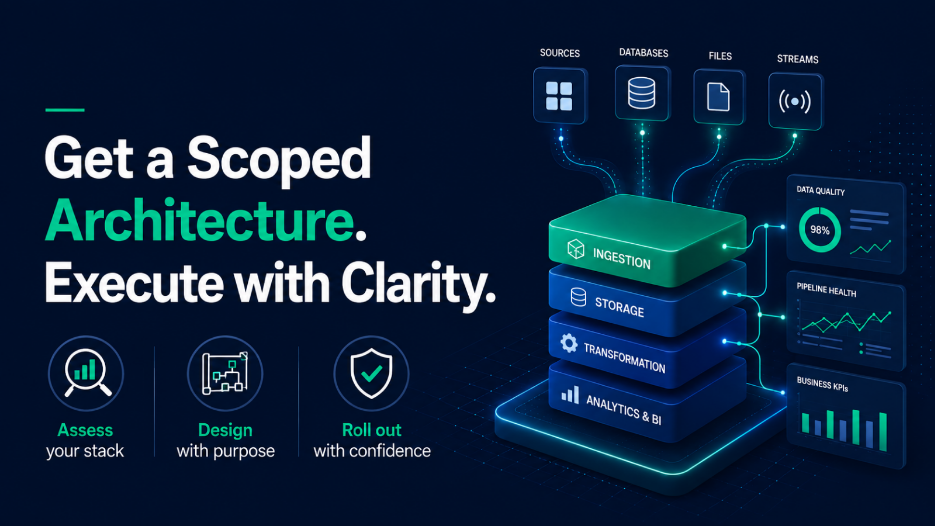
The output is usually a two-part deliverable:
A Target Architecture
This defines how your data infrastructure should be structured. It covers data ingestion, transformation logic, and storage strategy. It also defines how BI infrastructure connects to downstream users and systems. For cloud-based enterprises, this often means building cloud-native data platforms. Common choices include Snowflake, Databricks, and BigQuery. The architecture is designed around your team’s capabilities and future growth. It also aligns with your actual data volume and performance requirements.
A Phased Rollout Plan
Architecture means nothing without a delivery plan. This outlines the sequence of work, dependencies, team requirements, and realistic timelines. It accounts for existing technical debt and avoids the trap of trying to rebuild everything at once. A strong deployment plan identifies quick wins that deliver value early. These early results build momentum before the larger implementation is complete.
Why Do Businesses Need Data Engineering Consulting?
The answer is that most internal teams are too close to the problem.
Engineers deeply understand their systems, but may miss broader industry patterns. External expertise helps determine gaps and scalable approaches. They’re also operating with constraints that an outside consultant isn’t. Internal politics and established habits can limit broader thinking. The pressure to maintain existing systems often makes strategic planning difficult.
And most data teams are already fully loaded just keeping current systems running. Asking them to assess, design, and rebuild simultaneously is the main cause for slow progress and incomplete work.
A data architecture consulting engagement brings an objective outside perspective. It also provides dedicated focus and a structured planning process. You get a full assessment of your data engineering strategy in weeks, not quarters. You also get accountability. A scoped engagement has defined deliverables and a finish line, which internal projects often lack.
For enterprises in the USA, UAE, and UK managing distributed data across multiple business units, this matters even more. Inconsistent definitions, siloed pipelines, and weak governance create growing challenges. The longer they remain unresolved, the greater the impact on the business. The cost of fixing them grows with time.
The Core Components of a Scoped Data Architecture
A strong enterprise data architecture consulting engagement should address these areas:
Data Governance Framework
Who owns each data domain? What are the definitions, access rules, and quality standards? Without governance, you’re building on sand. Teams will continue producing conflicting reports, and no one will know which number to trust. A strong data governance framework defines ownership and quality standards. It ensures data remains reliable and scalable as the organization grows.
Data Infrastructure Planning
What does your current infrastructure actually support? Where are the bottlenecks? What needs to be re-platformed versus extended? Data infrastructure planning isn’t about chasing the newest tools. It’s about building data systems for where your business is headed. Not just solving today’s challenges, but supporting future growth and needs.
Data Workflow Optimization
How do raw events become reliable, business-ready datasets? This covers transformation logic, orchestration, testing, and monitoring. Many enterprise workflows work, but remain fragile and inefficient. When issues occur, they can be difficult and time-consuming to troubleshoot. Data workflow optimization rebuilds those processes with maintainability and reliability in mind.
Real-Time Data Processing
If your business needs fresh data, not just nightly batches, your architecture has to be designed for it from the start. Retrofitting real-time capability is expensive and painful. For fraud detection, inventory management, or personalization, latency requirements must be defined early. A strong data engineering strategy accounts for these requirements from the start.
Business Intelligence Infrastructure
The data platform exists to serve business decisions. The architecture needs to account for how analysts and data scientists will access, query, and trust the data. A strong BI infrastructure connects tools to clean, documented, and structured data. It eliminates reliance on raw tables with unclear ownership and definitions.
How Enterprises Build a Future-Ready Data Foundation?
The companies that get this right share a few traits.
They treat data infrastructure planning as a business problem, not just a technical one. They involve analytics, operations, and product teams early in the design process. Requirements identified early are far easier and cheaper to address.
They build governance into the architecture instead of bolting it on later. Data governance is often treated as something to worry about once the pipelines are running. In practice, retrofitting governance onto an existing system is one of the hardest and most expensive things a data team can do.
They also phase their rollout. Trying to modernize everything at once is a reliable way to delay everything. A well-scoped plan prioritizes high-impact work and sequences the rest effectively. It keeps the business running while the new architecture is built in parallel.
At Aiimone, we’ve seen that enterprises with a clear data strategy build better products and make faster decisions. They also spend far less time fixing data quality issues later.
Benefits of Data Engineering Consulting
Here’s what a well-run engagement delivers:
- A clear, documented data platform architecture your engineering team can build from.
- Reduced time-to-insight for analysts and BI teams.
- Lower risk when migrating to cloud-native data platforms.
- A data governance framework that scales with your organization.
- Confidence that your data infrastructure supports business goals. Not just technical preferences or short-term needs.
- Faster onboarding through clear architecture documentation. New engineers can understand systems and decisions more quickly.
- A shared language between technical and non-technical teams around data ownership and quality.
Final Remarks
In conclusion, Bad data engineering architecture doesn’t announce itself. It shows up slowly, as a report that takes too long, a metric that means two different things to two different teams, or a migration that keeps getting pushed because no one is confident the new system is ready.
A scoped data engineering consulting engagement stops that pattern before it compounds. You get a tailored architecture and a clear rollout plan with defined milestones. Your team knows exactly what to build next, without uncertainty or rework.
The enterprises pulling ahead on data aren’t the ones with the most tools. They’re the ones with a clear strategy and the discipline to execute it in the right order.
If your data structure has outgrown your current setup, now is the right time to get a plan in place.