Two questions keep coming up in boardrooms across the USA, UAE, and UK right now: “Do we move to the cloud, or do we fix what we already have?” Both paths fall under digital transformation. Both cost real money. And both carry real risk if you pick the wrong one.
The right application modernization strategy delivers results faster. The wrong one can leave teams solving the same problems for years. Enterprise cloud migration, legacy systems, or faster development. Your modernization choice shapes what comes next.
Learn the key differences between cloud migration and app modernization to make the right decision.
What Is Cloud Migration?
Cloud migration is the process of moving existing systems from premises to cloud platforms.
The application itself hasn’t changed much. The code is roughly the same. You’re lifting it out of one environment and placing it in another.
Enterprise cloud migration is often considered the faster option. In some cases, that’s true. A straightforward rehosting process can move workloads in weeks and not months. Speed comes with a catch, where you carry your old problems with you.
A slow legacy application stays slow in the cloud. Migration alone won’t solve performance issues. You’ve changed the address, not the structure. This is why cloud modernization services for large organizations go well beyond a simple infrastructure move.
What Is Application Modernization?
Legacy application modernization takes a different approach. Don’t just move the application. Rebuild it for modern, cloud native structures.
What is application modernization in plain terms? It’s the process of transforming how an application works, not just where it lives.
Enterprise application modernization is typically a long-term involvement. This requires a deeper review of your codebase and integrations.
Application transformation at this level touches business process optimization as well. Modernization creates opportunities to streamline operations.
What Is the Difference Between Cloud Migration and App Modernization?
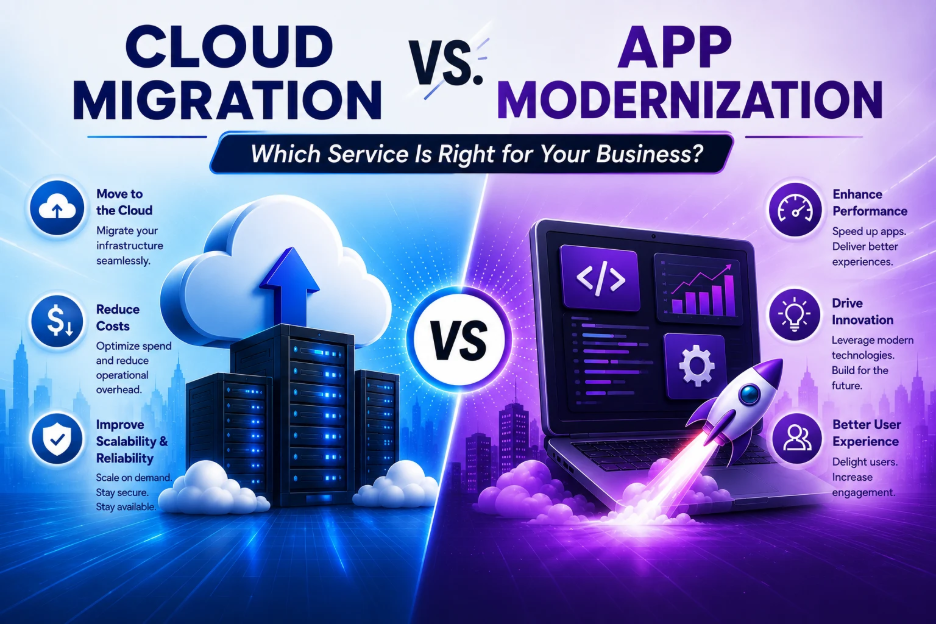
Cloud migration moves applications to the cloud with minimal changes. App modernization improves architecture, performance, and scalability.
They’re not opposites. Many enterprises do both. But they’re not the same investment and conflating them leads to budget surprises and missed outcomes.
The clearest way to think about it involves reviewing the cloud migration vs app modernization distinction from an architecture standpoint makes it clear that migration solves a location problem while modernization solves a structural one.
How Much Does Cloud Migration Cost Compared to Modernization?
Cost is where most decision-makers get tripped up.
Cloud migration services typically cost less upfront. Lift-and-shift engagements range from $50,000 to hundreds of thousands of dollars. Costs depend on tasks and cloud requirements.
Modernization costs more upfront but lowers long-term costs. Modernized applications need less maintenance and scale. Application modernization consulting firms can reduce infrastructure costs within 12 to 24 months.
The real comparison isn’t migration cost vs. modernization cost. It’s the cost of each option over three to five years, including support, scaling, and the risk of doing nothing.
Which Is Better for Digital Transformation?
The honest answer: it depends on where your bottleneck is.
For organizations weighing cloud migration or app modernization for enterprises operating at scale across multiple regions, the answer is often a phased approach.
Struggling with outdated infrastructure and rising costs? Cloud migration is often the best first step. Cloud infrastructure management improves flexibility and reduces hardware dependency.
If applications are slowing your business down. It’s time for an application to modernization strategy. Cloud migration alone won’t fix that.
Migrate stable systems, modernize bottlenecks, and follow a clear roadmap.
Signs You Need Cloud Migration First
- Your on-premises infrastructure costs are growing faster than your revenue.
- You’re facing hardware end-of-life decisions in the next 12 to 18 months.
- Your applications work reasonably well, but they just run in the wrong environment.
- Your team needs faster provisioning and better disaster recovery in the cloud.
- Begin with lower-risk tasks to reduce complexity.
Signs You Need Application Modernization First
- Your development team spends more time fixing old code than building new features.
- Your application can’t be combined with modern tools or platforms without significant custom work.
- Scaling your application is expensive, slow, or both.
- You’ve had disruption or reliability issues that keep coming back.
- Cloud migration stalls when the application is the real issue.
The Case for a Combined Strategy
Most enterprises ultimately need both. The question is sequencing.
Start with stable workloads for a smoother transfer. Use that experience to build internal cloud competency. Modernize the applications that deliver the most business value.
This approach reduces risk and avoids overcomplicating modernization.
Aiimone helps enterprises plan migration and modernization. They do so with personalized roadmaps designed for enterprise needs.
What to Ask Before You Choose?
Before choosing a migration or modernization partner, ask these questions:
- What specific business outcome are you trying to achieve in the next 12 months?
- Are your applications structurally sound, or are they the reason you can’t move faster?
- What’s your team’s capacity to obtain change during the engagement?
- Do you have a clear owner for the post-migration or post-modernization environment?
- What does success look like, and how will you measure it?
These aren’t technical questions. They’re business questions. The technical decisions follow the answers.
Final Remarks
In conclusion, cloud migration and app modernization aren’t competing strategies. They’re different tools for different problems. The best results come from solving the right problem first.
If your structure is the issue, migrate. If your applications are the issue, modernize. If it’s both, build a plan that arranges them properly.
A clear application modernization strategy gives your business more than technical gains. Build faster, integrate smoothly, and scale with confidence. That’s the outcome worth planning for.