
British enterprises are under pressure to modernise. Rising energy costs, tighter data rules from the ICO, and customer expectations that never sit still have pushed cloud onto every board agenda. Yet moving tasks off obsolete infrastructure is not a switch to throw. If done poorly, it drains budgets, breaks compliance, and stalls delivery. Done well, it lowers running costs, improves capabilities, and frees teams to build new products faster.
That is where cloud migration services come in. The appropriate partner turns a risky programme into controlled, measurable steps. This guide explains what these services cover and how they reduce risk. It also shows UK businesses how to build a strong case for ROI.
What are cloud migration services?
Cloud migration services move applications, data, and infrastructure from legacy systems to the cloud. This can include public, private, or hybrid cloud environments. They usually bundle four things: assessment, planning, execution, and post-migration support.
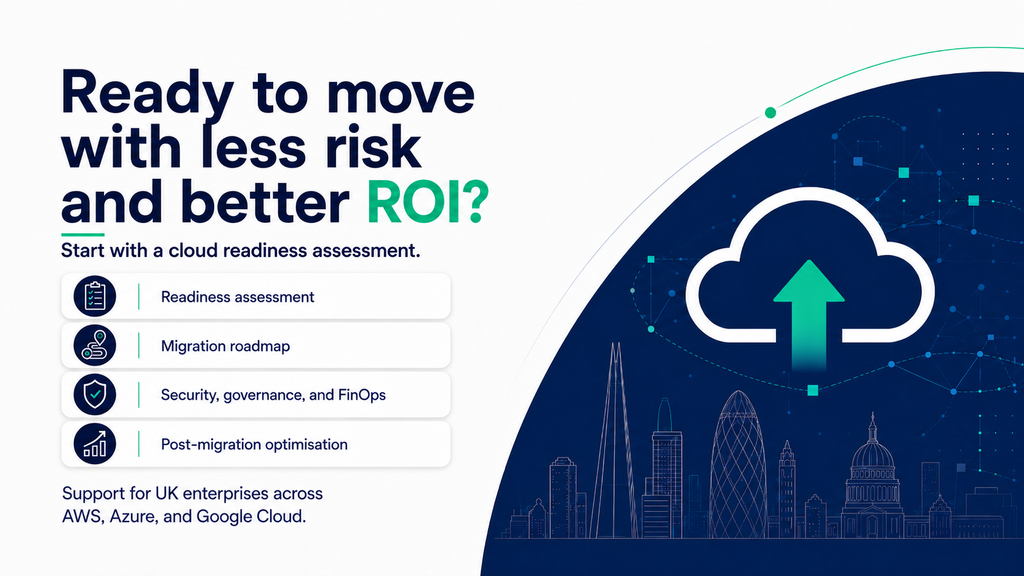
A proper engagement starts with a cloud readiness assessment. Consultants assess each workload and choose the right migration path. They also determine technical debt and hidden dependencies early. A cloud migration roadmap defines priorities, timelines, and success measures.
Execution moves workloads to the cloud, from simple rehosting to deeper refactoring. Post-migration work covers cost optimisation, monitoring, and governance. This helps protect savings after the move.
Why are UK businesses moving to the cloud now?
The UK cloud market is now central to how businesses run. Gartner projected public cloud spending to reach about $723 billion in 2025. That represents roughly 21% growth from the previous year. More than half of UK businesses use paid cloud computing services. Adoption is highest in the information and communications sector.
There is a cost driver too. Flexera reports that organisations waste around 30% of cloud spending. Idle resources and poor sizing are major causes. This makes cloud migration consulting more valuable for controlling costs. Migration should go beyond a simple infrastructure move.
Three UK-specific pressures are speeding up the shift:
- ICO inspection on data handling and cross-border transfers.
- Net-zero commitments that make efficient hyperscaler regions attractive.
- FCA and PRA expectations for operational resilience in regulated sectors.
How does cloud migration reduce business risk?
Risk shows up in three places, such as technical, financial, and regulatory. Well-designed cloud migration solutions address each one.
Cloud platforms reduce technical risk with redundancy, failover, and automated patching. Workloads can run across multiple availability zones instead of one data centre. Recovery time objectives shrink from hours to minutes.
Financial risk drops because capital spend on hardware refresh cycles converts into predictable operating spend. Usage-based pricing cuts waste, as cost tools flag overspending early.
Regulatory risk drops when a consulting partner bakes UK and EU rules into the target architecture from day one. That means UK data residency where required, encryption in transit and at rest, audit logging that satisfies the ICO, and access controls mapped to internal policy. Regulated firms must also meet FCA and PRA requirements for third-party services.
A structured cloud migration strategy also reduces the biggest hidden risk of all, such as the bungled migration itself. Assessment, pilot, wave planning, and rollback design turn a leap of faith into a series of small, reversible moves.
How can cloud migration improve ROI?
Return on investment from cloud transformation services comes from four sources.
First, infrastructure savings. Retiring physical servers, network kit, and the estate costs behind them, such as power, cooling, and floor space, removes a fixed drag on the balance sheet.
Second, licensing and support consolidation. Legacy system migration often ends years of overlapping vendor contracts and specialist support agreements.
Third, developer productivity. Managed services, CI/CD pipelines, and infrastructure as code mean feature releases in days rather than months. McKinsey research on cloud economics has estimated that the largest share of cloud value comes from business acceleration rather than pure cost cuts, which you can verify against the latest McKinsey Cloud Value report.
Fourth, revenue enablement. Cloud-native architectures make it easier to launch new digital channels, personalise customer journeys, and plug in analytics or AI services that would be prohibitive on-premises.
The ROI case only holds if you measure it. Baseline current costs and delivery velocity before you start, then track the same metrics quarterly after each migration wave. Without a baseline, savings claims are guesswork.
Building a cloud migration strategy for businesses
A workable cloud migration strategy for businesses follows a clear sequence.
- Discovery and cloud readiness assessment
- Business case and target operating model
- Cloud migration roadmap and wave planning
- Pilot migration and validation
- Production waves with rollback options
- Optimisation, governance, and FinOps
Skipping any of these phases is where most programmes come unstuck. Discovery without a business case leaves finance unconvinced. A pilot helps prevent costly production issues. Production waves without a FinOps discipline ruin the ROI you promised.
DIY migration vs consulting-led migration
| Factor | DIY migration | Consulting-led migration |
| Time to first workload | 6 to 12 months | 6 to 12 weeks |
| Typical cost overrun | 30% to 50% | Under 15% with governance |
| Rework rate | High, common re-architecture | Lower, assessment led |
| Compliance readiness | Ad hoc | Mapped to ICO, FCA, PRA |
| Post go-live optimisation | Rarely resourced | Standard scope item |
How much does cloud migration cost?
There is no single price tag. Enterprise cloud migration services are usually priced against workload count, complexity, and target architecture. Rough UK market bands look like this:
Small estate rehost (10 to 30 workloads):
£75,000 to £250,000.
Mid-market replatform (30 to 150 workloads):
£250,000 to £1.2 million.
Large-scale refactor and modernisation programmes:
£1.5 million upwards.
These figures cover consulting, tooling, and initial run costs, and not ongoing cloud consumption. The bigger question is total cost of ownership over three to five years. A well-run programme typically returns its migration cost within 18 to 30 months through infrastructure savings and productivity gains. A poorly scoped one can take twice as long or never break even.
Fixed-price waves with clear exit criteria are safer than time-and-materials engagements for organisations new to the cloud.
Choosing a cloud migration consulting company
The best cloud migration services in the UK share a few traits. They lead with assessment rather than tooling. They hold current certifications with major hyperscalers. They can show named case studies in your sector, and not generic logos. They price outcomes, and they include FinOps and security specialists on the same team as the engineers.
Ask any prospective cloud migration consulting company four questions:
- How do you handle rollback if a production wave fails?
- What is your approach to cloud cost optimisation after go-live?
- How does the target design meet ICO, FCA, or PRA requirements?
- Who owns knowledge transfer, and when?
Aiimone offers cloud migration consulting services for UK enterprises, covering readiness assessment, roadmap design, and post-migration optimisation across AWS, Azure, and Google Cloud, with governance mapped to ICO, FCA, and PRA expectations.
Conclusion
Cloud migration services are no longer optional for UK businesses that want to compete on cost, speed, and resilience. The benefits include lower costs, faster delivery, and stronger compliance. Risk increases when migration skips discovery, FinOps, or business planning. A clear cloud migration strategy, delivered in waves with measurable outcomes at each step, is what turns cloud transformation services from a line item into a return.