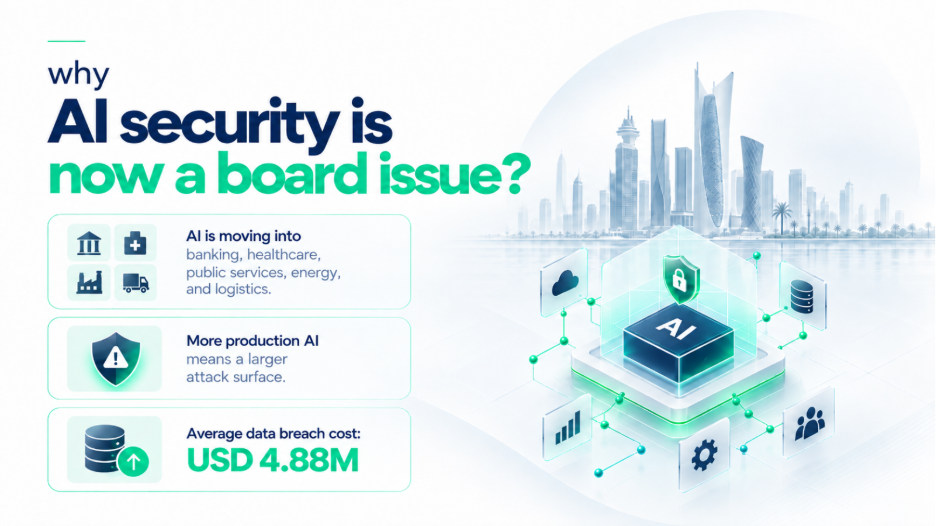
Businesses can reduce AI risks through governance, monitoring, data protection, and training. Specialist cybersecurity services can protect AI systems from data ingestion through production use. AI is no longer a pilot project in Qatar. It is now in core banking workflows at institutions supervised by Qatar Central Bank, in clinical decision support at hospitals under the Ministry of Public Health, in citizen-facing services being rolled out under the TASMU Smart Qatar programme, and in the operational backbone of energy and logistics firms that anchor the national economy. Every one of those deployments creates value. Every one of them also opens a new attack surface that traditional cybersecurity tools were not built to defend.
Why AI Security Risks Now Sit on Every Qatar Boardroom Agenda?
Qatar’s national digital agenda is accelerating AI adoption across major industries. As AI moves into production, business value grows, along with security risks.
As generative AI adoption grows, so does data breach risk. With breach costs averaging USD 4.88 million, AI security is now a business priority. The pace of adoption is outrunning the pace of control design.
For Qatari businesses, the challenge is adopting AI without creating regulatory, financial, or reputational risk.
What Are the Biggest Security Risks of AI?
AI introduces threats that traditional cybersecurity tools were never designed to catch. The most consequential include:
Prompt injection and jailbreaks:
Prompt injection can expose data or trigger unsafe AI actions.
Training data poisoning:
Attackers can poison training data, causing harmful outputs in sectors like banking and healthcare.
Model theft and inversion:
Proprietary models can be extracted through repeated queries, and personal data can sometimes be reconstructed from model responses. Both create direct PDPL exposure in Qatar.
Shadow AI:
Employees paste confidential data into public chat tools with no logging, no data residency, and no contractual protection.
Insecure AI supply chains:
Foundation models, embeddings, and third-party APIs bring inherited vulnerabilities that most procurement checklists still miss.
Agentic AI misuse:
As autonomous agents gain the ability to send emails, move money, or trigger tasks, a single compromised prompt can cause real-world damage in seconds.
Generative AI adds new security risks alongside phishing, ransomware, and insider threats. They do not replace them; rather, they multiply them.
How Can Businesses Reduce AI Security Risks?
A workable programme rests on five pillars.
Governance and AI security framework:
Use frameworks like NIST AI RMF or ISO/IEC 42001. Align controls with Qatar’s PDPL and relevant cybersecurity and sector rules.
Data protection:
Classify data before it touches a model. Mask, tokenise, or redact personal and financial fields. Keep sensitive workloads inside Qatar-based cloud regions where residency is required.
Model lifecycle security:
Assess AI security across the full model lifecycle. Red team every production model against prompt injection, jailbreaks, and data exfiltration.
Runtime AI threat protection:
Position AI-aware gateways that inspect prompts and responses. Log every model call. Rate limit sensitive queries. Apply zero trust between agents, tools, and data sources.
People and process:
Train staff on shadow AI risks, disclosure requirements, and safe prompt hygiene. Make responsible AI use part of onboarding, and not an annual slide deck.
What Security Controls Should Businesses Use for AI?
This comparison shows where traditional security falls short and where AI-specific controls are needed. The table below highlights the key differences.
| Control area | Traditional cybersecurity | AI-specific cybersecurity |
| Threat model | Networks, endpoints, users | Prompts, models, training data, agents |
| Data protection | DLP, encryption, access control | Plus tokenisation of training data, prompt scrubbing, output filtering |
| Monitoring | SIEM, EDR, NDR | Plus prompt and response logging, drift detection, hallucination scoring |
| Testing | Pen testing, vulnerability scans | Plus red teaming for prompt injection, jailbreaks, model inversion |
| Identity | IAM, MFA, PAM | Plus agent identity, tool permissions, action approvals |
| Compliance anchor | PDPL, ISO 27001, PCI DSS | Plus NIST AI RMF, ISO/IEC 42001, OWASP LLM Top 10 |
| Governance owner | CISO | Shared: CISO, Chief Data Officer, AI ethics lead |
The point is not to replace existing controls. Treat AI as a core asset with dedicated risk, testing, and incident response controls.
How Can Companies Prevent Prompt Injection Attacks?
Prompt injection is the most talked-about AI threat, and also the most misunderstood. It cannot be solved with a single filter. A layered approach works best:
- Separate trusted system prompts from untrusted user input at the application layer.
- Treat external content from websites, emails, PDFs, and APIs as untrusted.
- Limit agent access and require human approval for sensitive actions like payments or data exports.
- Position an AI gateway that inspects prompts and outputs in real time and blocks known attack patterns.
- Log everything. Review logs weekly for anomalies.
- Run structured red team exercises quarterly using OWASP LLM Top 10 as the baseline.
No control is perfect on its own. Defence in depth is the only realistic posture.
Enterprise AI Security Risk Management for Regulated Sectors
Banks, insurers, telcos, and healthcare providers in Qatar must ensure AI decisions are explainable and auditable. They must also align AI use with relevant customer protection rules.
Enterprise AI security risk management in this context means:
- A single AI inventory that lists every model, its owner, its data sources, and its risk tier.
- Documented model cards and data sheets for every production system.
- Independently validate high-impact models before launch.
- Continuous AI security monitoring with alerts routed into the SOC, not a separate silo.
- Board-level reporting on AI risk, at the same cadence as cyber risk.
Firms that embed these habits early spend far less time retrofitting controls when regulators publish binding AI guidance, which is expected across the GCC over the next two years.
Cybersecurity Solutions for Generative AI: What to Look For
When evaluating AI security solutions or hiring AI cybersecurity experts, buyers in Qatar should test vendors against a short checklist:
- Do they cover the full lifecycle, from data readiness to runtime monitoring?
- Can they map their controls to NIST AI RMF, ISO/IEC 42001, and PDPL in one view?
- Do they understand data residency requirements for regulated workloads?
- Can they integrate with your existing SOC, IAM, and DLP tools?
The best AI cybersecurity services are not the loudest. They are the ones that fit inside your governance model and make your CISO’s life easier, not harder.
Building a Cybersecurity Strategy for AI Adoption in Qatar
A practical rollout for a mid- to large Qatari enterprise looks like this:
Discovery (weeks 1 to 4):
Inventory every AI use case, sanctioned and shadow. Classify by risk tier.
Framework alignment (weeks 4 to 8):
Map controls to NIST AI RMF, ISO/IEC 42001, PDPL, and sector rules.
Quick wins (weeks 4 to 12):
Deploy an AI gateway, enable prompt and response logging, publish an acceptable use policy for generative AI.
Assessment and red team (weeks 8 to 16):
Run an AI security assessment against the highest tier systems.
Runtime and response (from month 4):
Wire AI alerts into the SOC, define incident playbooks specific to model abuse, and rehearse them.
Continuous improvement (ongoing):
Quarterly red teams, annual framework reviews, board reporting.
This sequence keeps momentum without over-engineering the first six months.
Where Specialist Partners Fit In
Most in-house teams in Qatar are lean. They already carry cloud, DevSecOps, and regulatory workloads. Adding deep AI security expertise to that plate is difficult. Specialist providers like AiimOne bring AI security expertise, testing tools, and framework knowledge. This lets internal teams focus on governance while keeping pace with AI threats.
Final Remarks
AI adoption in Qatar is moving faster than most security programmes can keep up with. The organisations that will stay ahead are not the ones buying the most tools, but the ones treating AI systems as first-class assets with their own governance, their own testing cadence, and their own place on the board risk register.
The five pillars in this article, governance, data protection, model lifecycle security, runtime threat protection, and people, are not aspirational. They are the baseline any Qatari enterprise handling regulated data should already be building toward. Aligning AI security with Qatar’s national and sector rules creates a stronger, defensible business position.
Prompt injection, shadow AI, and agentic misuse will not wait for regulators to catch up. Formalise AI security and connect model activity to your SOC before an incident happens.