Every UK board is being asked the same question this year: What is our AI plan? The pressure is real. Customers expect smarter products. Investors want an AI story. Competitors are already shipping. The instinct for many CTOs is to hire a small team and build. It feels like a safe, controlled option. In practice, it is often the slowest and most expensive route to a working product. The alternative is to partner with an AI application development company that already has the talent, the tooling, and the delivery patterns in place. Hire externally when speed matters, senior AI expertise is missing, or strict compliance is required. Build in-house only if AI is a core capability, you have MLOps talent, and you’re ready for long-term investment. Most UK firms should start with an AI partner, then move key work in-house as they grow.
Why Is AI Development a Growing Priority in the UK?
The UK AI market is one of the largest in Europe. Government estimates place it at over £16 billion, with strong growth forecast throughout the decade. Meanwhile, the ONS and industry surveys report persistent shortages of senior AI and data engineering talent. Recruiters in London and Manchester quote 4 to 6 months to fill a single senior ML role, and salary bands keep climbing.
Boards want AI features shipped this year, not staffed this year. That gap is what an AI development services company solves.
Regulation adds another layer. The EU AI Act now applies to UK firms serving EU users. The ICO expects clear data protection impact assessments for high-risk models. The FCA has issued guidance on AI in financial services. A partner who has already shipped compliant systems saves months of legal and architecture rework.
What does an AI application development company actually do?
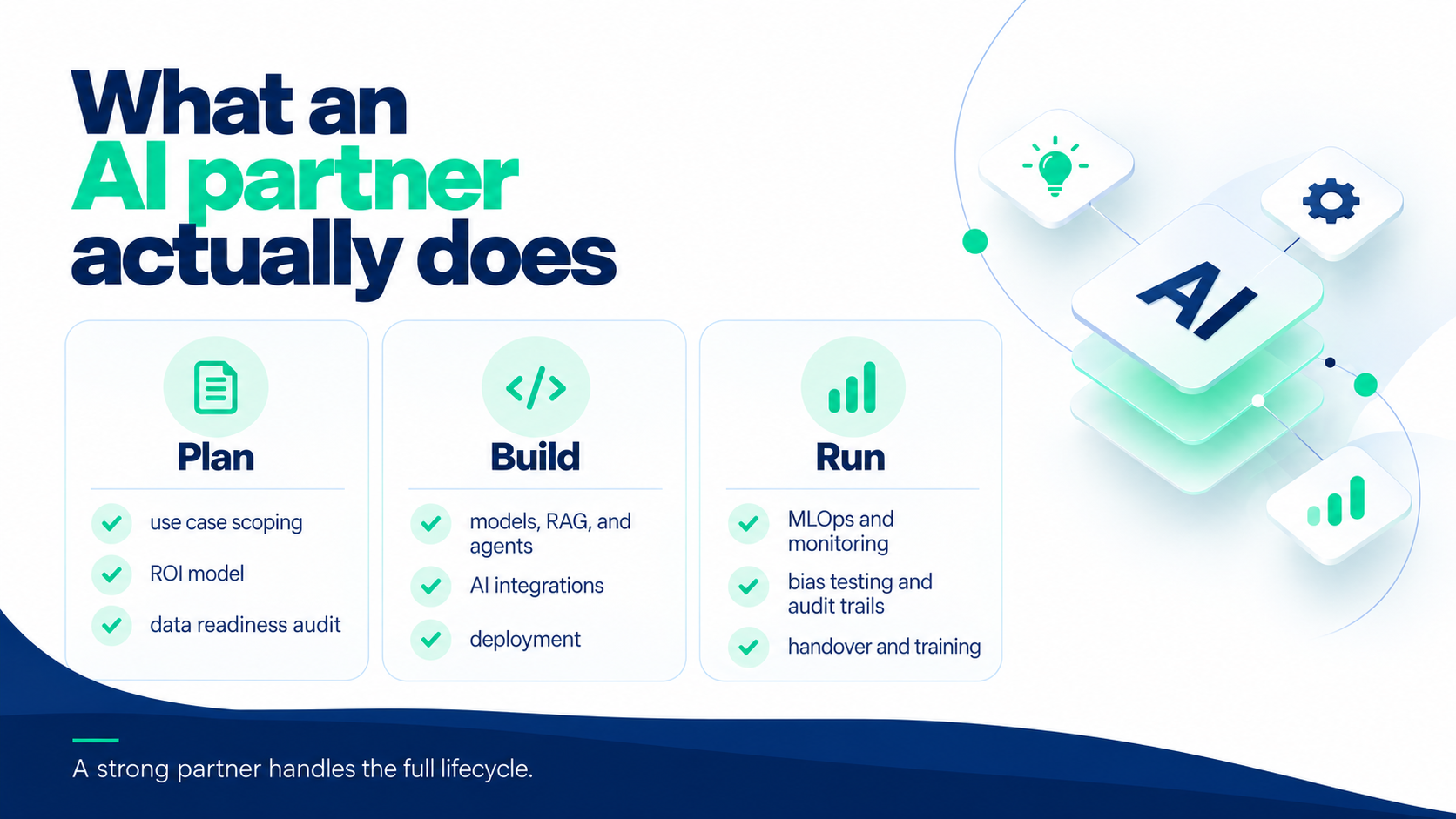
A good partner handles the full lifecycle of custom AI application development:
- Discovery and use case scoping, with a clear ROI model
- Data readiness audits and pipeline engineering
- Model selection (foundation models, fine-tuning, or bespoke training)
- Prompt engineering, RAG systems, and agentic workflows
- MLOps: CI/CD for models, monitoring, drift detection, retraining
- AI integration services into your existing stack (CRM, ERP, data warehouse)
- AI deployment services on your chosen cloud or on-premises
- Governance, red teaming, bias testing, and audit trails
- Handover, documentation, and staff training
The scope goes well beyond writing code. It covers artificial intelligence development, generative AI development, and the operational discipline needed to keep models useful in production.
The real cost of building AI in-house
The sticker price of a small team looks manageable until you add everything up. Here is a realistic view for a UK enterprise standing up its first serious AI application.
| Senior ML engineer (2 FTE) | £220,000 | Included in engagement |
| Data engineer (1 FTE) | £85,000 | Included |
| MLOps engineer (1 FTE) | £95,000 | Included |
| Product manager (0.5 FTE) | £45,000 | Included |
| Recruitment and onboarding | £60,000 | £0 |
| GPU compute and tooling | £70,000 | £40,000 (shared licences) |
| Governance, legal, DPIA work | £50,000 | £15,000 |
| Time to first production model | 12 to 18 months | 3 to 5 months |
| Estimated year one total | £625,000+ | £280,000 to £420,000 |
Figures are illustrative estimates based on typical UK market rates. Verify against current recruitment data and vendor proposals before the board sign-off.
The point is not that in-house is always more expensive. It is that year one costs are almost always higher, and value lands much later. That delay has its own price: competitors ship, customers churn, and the internal AI programme loses executive backing.
How long does AI application development take?
For a focused first project (one clear use case, clean data, defined success metric), a competent AI development company can typically deliver:
4 to 8 weeks:
Discovery, data audit, proof of concept
8 to 16 weeks:
Pilot in production with a small user group
16 to 24 weeks:
Scaled rollout with monitoring and governance
An in-house team starting from zero rarely matches this. Hiring alone takes a quarter. Then the team has to build the platform before they can build the product. Most firms see their first real production model 12 to 18 months after kickoff.
Should companies build AI applications in house?
Yes, in specific cases:
- AI is your product, not a feature. If your business model depends on proprietary models, keep the IP inside.
- You already employ senior ML leadership.
- Your data is so sensitive that no external access is acceptable, even under NDA and secure enclaves.
- You have a 3- to 5 year investment horizon and board support to match.
For everyone else, the honest answer is a hybrid. Bring in an AI development services company to ship the first two or three applications. Use that engagement to train an internal core team. Move the platform work in-house once you have proof of value and hired senior talent.
Benefits of hiring an AI application development company
The main benefits go beyond speed and cost:
Access to senior talent:
A firm that already ships enterprise AI development work has principal engineers you would struggle to hire directly.
Proven reference architectures:
No greenfield mistakes on vector stores, orchestration, or evaluation harnesses.
Compliance patterns:
Templates for DPIAs, model cards, and audit logs that satisfy the ICO and sector regulators.
Cross-industry pattern library:
Fintech RAG patterns transfer to healthcare triage; retail personalisation transfers to public sector citizen services.
Predictable commercials:
Fixed scope statements of work, or capped time and materials, beat open-ended hiring risk.
Faster failure:
A partner will tell you a use case is weak in week 3. An internal team, with jobs on the line, often takes 9 months.
What to look for in an AI application development company?
Not every vendor is worth hiring. Ask for:
- Named production case studies with measurable outcomes (not pilots that never shipped)
- References you can actually call
- A named delivery lead, not a rotating team
- Clear IP terms: your data, your models, your prompts
- Security certifications (ISO 27001 at minimum, SOC 2 for US work)
- A written approach to EU AI Act risk classification
- Evaluation and monitoring practice, not just build and hand over
Firms like Aiimone position around this full lifecycle model, combining product engineering with governance and MLOps as a single delivery motion, which is the pattern UK buyers should expect from any serious partner.
AI development company vs in-house team: a decision framework
Use this quick check:
- Do you need production value in under 6 months? Hire a partner.
- Do you have a senior ML lead already in seat? In-house is viable.
- Is your first use case exploratory? Partner (they will kill weak ideas faster).
- Is AI your core product? Hybrid, with in-house ownership of IP.
- Are you in a regulated UK sector? Partner with a compliance track record.
- Do you have board approval for a 3 year AI platform investment? In-house or hybrid.
Common risks and how to manage them?
Outsourcing AI has real risks. Manage them, do not ignore them.
Lock-in:
Insist on standard tools (LangChain, Kubernetes, standard vector DBs) and full source handover.
Data leakage:
Use secure enclaves, tokenisation, and contract clauses that ban training on your data.
Shallow work:
Require production metrics in every milestone, not just demos.
Knowledge loss:
Build a shadow internal team from day one so the partner leaves capability behind.
Conclusion
The choice is not really “build or buy”. It is “how fast do you need to move, and where do you want the IP to sit?” For most UK enterprises facing pressure from the board, from customers, and from regulators, hiring an AI application development company is the faster, lower-risk path to real value. Keep the strategy in-house. Bring in a partner to ship the first products. Grow the internal team once you have proof, patterns, and a platform worth owning.