
Healthcare organizations today are falling into disconnected systems. Patient records live on one platform, billing in another; lab results somewhere else entirely. Staff spend hours every week doing manually what Healthcare Technology Solutions should handle automatically.
The fix is system integration in healthcare, and most organizations know they need it. What they can’t agree on is who should build it.
Do you invest in an in-house team that knows your infrastructure inside and out? Or do you bring in an external partner who’s done this many times before and can hit the ground running?
Both paths have real merits. Both carry real risks. The cost difference between them is high enough to change how you budget for the next two or three years.
This guide breaks down system integration healthcare, with actual cost comparisons, timelines, and specific scenarios. You’ll have a clear picture of which approach fits your organization.
What Does System Integration Healthcare Actually Involves?
System integration in healthcare is more than connecting two software tools. These include HL7, FHIR, and HIPAA-compliant healthcare integration. Live patient data synchronization across systems and locations.
Getting it wrong doesn’t just slow you down. This creates regulatory risks, billing errors, and gaps in patient care.
The In-House Healthcare IT Team: Real Strengths, Real Costs
There’s a genuine appeal to keeping things internal. Your team knows your systems, your tasks, and your compliance requirements. They’re available. They’re accountable. You control the road map.
But here’s what the numbers usually reveal.
What you’re paying for:
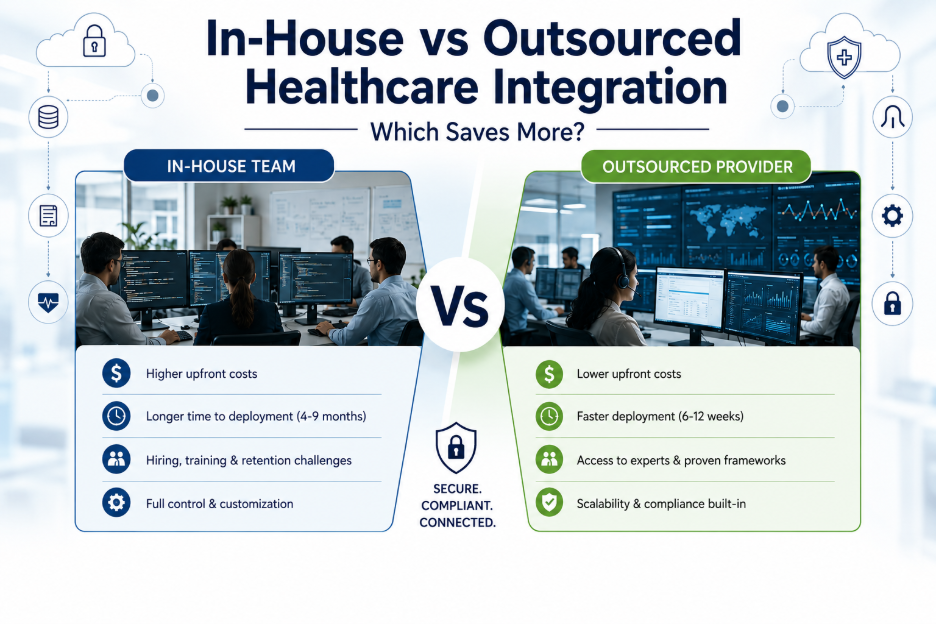
- Senior integration engineers: $110,000 to $160,000 per year each
- Benefits, training, and HR overhead on top of that
- Licensing for integration platforms and middleware
- Time lost during onboarding (typically 3 to 6 months before productivity)
- Ongoing maintenance as regulations and systems change
A medium-sized hospital is building a capable in-house healthcare IT team from scratch. This hospital could easily spend $500,000 or more in 1 year. They can do so before a single integration goes live.
And that’s before scope creep, staff turnover, or a sudden regulatory change forces you to rebuild something from the start.
Outsourced Healthcare Integration, What You’re Really Getting ?
Outsourced healthcare integration services have matured a lot over the past decade. You’re no longer choosing between a generic IT firm that’s “done healthcare before” and building everything yourself.
Today’s specialized providers come in with pre-built connectors, proven experience with healthcare API integration, and teams who’ve handled EHR migrations, payer systems, and patient portal connections across dozens of clients.
The practical advantages:
- Faster deployment. Pre-built frameworks cut months off typical timelines
- Predictable costs through fixed contracts or managed service pricing.
- Access to specialists across HL7, FHIR, DICOM, and other standards you may only need occasionally.
- Built-in knowledge of healthcare digital transformation trends and compliance requirements.
- Scalability without hiring
One area where this is especially visible is healthcare data exchange between disparate systems. Providers who do this all day have already solved the hard problems you’d spend months figuring out internally.
The Real Cost Comparison
| Factor | In-House Team | Outsourced Provider |
| Year 1 Cost | $400K to $700K | $80K to $250K |
| Time to First Integration | 4 to 9 months | 6 to 12 weeks |
| Compliance Coverage | Depends on team | Built-in, updated regularly |
| Scalability | Hire more people | Adjust contract scope |
| Staff Turnover Risk | High | Low |
| Long-Term Control | High | Moderate |
These are ranges, not guarantees. Your actual numbers depend on your organization’s size, the complexity of your systems, and how many integrations you need.
But the pattern holds across most comparisons: outsourcing wins on speed and early-stage cost, while in-house builds long-term depth if you’re willing to invest over several years.
When In-House Makes Sense
Don’t write off the internal model without asking a few questions first.
In-house works better when:
- You’re a large enterprise with 10 or more active integrations running simultaneously.
- You have existing IT staff who can be upskilled rather than hired from scratch.
- Your integration needs are highly customized and change frequently.
- You handle extremely sensitive data with strict internal security policies.
- You’ve already invested in enterprise healthcare integration solutions comparison and just need people to run them.
If you’re operating on a scale with stable, complex requirements, building internal capability over time can pay off.
When Outsourcing Makes More Sense?
For most small to mid-sized healthcare IT services, the math tips the other way.
Outsourcing works better when:
- You need something performing in weeks, and not quarters.
- You don’t have the budget or pipeline to justify full-time integration of engineers.
- You’re going through a healthcare digital transformation with multiple moving parts at once.
- You need specialized expertise for a specific project (EHR migration, payer API, patient portal).
- You want predictable monthly costs without HR overhead.
This is also where working with a focused healthcare IT outsourcing company pays off. A partner like Aiimone brings structured implementation experience specifically built around healthcare interoperability and compliance, which is very different from a general IT services firm trying to figure things out as they go.
The Hybrid Model Worth Considering
Many organizations end up here, and it’s not a cop-out.
You keep a small internal team focused on negligence and vendor management. You outsource the heavy technical work, specialized builds, and compliance-sensitive incorporations to a partner with the right credentials.
This gives you control without the full cost of an in-house build. It also reduces your exposure if a key engineer leaves.
What Actually Drives ROI in Healthcare Integration?
Whether you go in-house or outsource, the same factors determine whether you see a return.
Speed to deployment:
Every month, a broken incorporation sits unresolved, costing money in manual workarounds, staff time, and data errors.
Compliance accuracy:
One HIPAA violation can wipe out two years of cost savings on a project.
Data quality:
Patient data synchronization that creates downstream billing and care coordination problems. These issues are expensive to fix.
Scalability planning:
The cheapest option today that can’t grow with you will cost you more in 18 months.
Final Remarks
In conclusion, system integration in healthcare isn’t a one-time project. It’s an ongoing commitment that grows with your organization, your technology stack, and the regulatory landscape around you.
The in-house vs outsourced debate doesn’t have a universal winner. What it has is context. Your budget, your team, your timeline, and how complex your systems are will point you toward the right answer faster than any general comparison will.
Manual workarounds, compliance gaps, and disconnected patient data don’t just slow operations down. They create real risk, financial and clinical.
For most healthcare organizations in the US, UAE, and UK right now, outsourcing that work to a specialized partner gets you there quicker, with less internal strain, and at a lower cost in the short to medium term.