British boards are done treating AI as an experiment. It’s now a line item, a hiring priority, and in many cases a source of measurable margin. The question in most planning meetings isn’t whether to build with AI, but who to build with. Choosing the right partner is the single decision that separates a working system from a stalled proof of concept.
This guide walks through the top AI development company shortlist for 2026, the services AI development companies offer, a framework for matching partners to organisation size, and a practical checklist for procurement teams across the UK. If you’re preparing to hire AI development company support for a serious enterprise programme, you can start here.
Why the AI partner decision matters more in 2026?
Gartner projects global generative AI spending to hit $644 billion in 2025, up 76%. IDC forecasts total AI spending will climb to $632 billion by 2028. McKinsey’s most recent State of AI survey found that 65% of organisations now use generative AI regularly, roughly double the figure from a year earlier.
The UK sits near the front of that curve. The UK aims to become a global AI leader, and enterprises are responding. Yet the same McKinsey research shows that fewer than one in ten companies report meaningful bottom-line impact from generative AI so far. In 2026, your choice of AI provider can determine whether AI spending delivers real value.
What services do AI development companies offer?
Modern AI development companies are no longer just modelling shops. A credible partner today covers the full stack:
AI strategy and use case discovery:
Prioritising where AI actually pays back.
Data engineering and AI readiness:
Data pipelines, quality controls, governance, and the infrastructure that supports AI models.
Machine learning development:
Machine learning for forecasting, detection, classification, and pricing.
Large language model development:
Fine-tuning, retrieval-augmented generation, and evaluation harnesses.
AI agent development:
Multi-step reasoning agents that call tools, browse systems, and complete real work.
AI application development services:
The web, mobile, and back office interfaces that turn models into products.
MLOps and platform engineering:
This involves CI/CD for models, monitoring, drift detection, and cost control.
AI security and responsible AI:
Red teaming, prompt injection defence, and alignment with the EU AI Act and the UK’s principles-based approach.
The best AI development companies for custom AI solutions treat these as one continuous discipline rather than isolated services.
AI development frameworks by organisation size
Not every business needs the same operating model. The table below is a practical view of how AI development frameworks tend to map to company size in the UK market.
| Organisation size | Typical AI operating model | Partner profile that fits |
| Small (under 250 staff) | One or two focused use cases, mostly SaaS with light customisation | Boutique custom AI development companies, fixed-scope engagements |
| Mid market (250 to 2,000) | Two to five production systems, growing MLOps needs | Specialist AI solution providers with vertical depth |
| Large enterprise (2,000 to 20,000) | Portfolio of models, central platform, federated squads | Mid to large firms offering AI application development services plus governance |
| Global enterprise (20,000+) | Enterprise AI factory, regulated environments, multi-region | Global systems integrators with regulated industry track record |
Match the partner to the maturity you’re aiming for, and not the size you are today. Buying too much scale early is as risky as buying too little.
Top AI development companies to consider in 2026
The shortlist below is drawn from firms with visible UK delivery, published enterprise case studies, and credible investment in machine learning development and large language model development. Pricing figures are indicative day rates for UK engagements based on publicly discussed ranges and analyst commentary.
Aiimone
Aiimone is an AI solutions partner focused on custom development, agentic AI, and cloud delivery across global markets. The firm typically works with mid-market and enterprise teams that want senior engineering, faster cycles than a global systems integrator can offer, and a clear route from discovery to production.
Accenture
The largest force in enterprise AI consulting, with a reported $3 billion investment in its data and AI practice and tens of thousands of trained AI practitioners. Strong fit for regulated UK sectors, such as banking, insurance, public services, and life sciences. This is best when you need scale, change management, and a single throat to choke.
IBM Consulting
Anchored by the watsonx platform and a growing agentic AI portfolio. Deep experience with hybrid cloud AI and governance-heavy workloads. A natural pick for financial services and central government where explainability and data residency dominate.
Capgemini
European heritage matters for UK buyers with EU data flows. Capgemini’s generative AI practice has scaled quickly, and its industry cloud offerings pair AI with core modernisation, useful for insurers and manufacturers running legacy estates.
EPAM Systems
Engineering-led, with a strong reputation for platform work and product-grade delivery. A good fit when you want AI-powered applications built like real software, not lab demos.
Infosys
The Topaz suite has given Infosys a clear generative AI narrative, and its UK footprint is substantial. Strong at large-scale outsourcing that blends AI with application modernisation and business process services.
Persistent Systems
Product engineering DNA and a growing generative AI services line. Strong for independent software vendors and software product owners embedding AI into their own offerings.
Thoughtworks
Long-standing reputation for engineering excellence and responsible technology. A good pick when culture, quality, and continuous delivery matter as much as the model itself.
Comparison at a glance
| Company | Best for | UK presence | Day rate (GBP) | Notable strength |
| Accenture | Global enterprise, regulated | Very large | £1,200 to £2,500 | Scale and change delivery |
| IBM Consulting | Governance-heavy AI | Large | £1,100 to £2,200 | watsonx and hybrid cloud |
| Capgemini | European enterprise | Large | £1,000 to £2,000 | Industry cloud plus AI |
| EPAM | Product grade AI apps | Medium to large | £900 to £1,700 | Engineering rigour |
| Infosys | Outsourced AI at scale | Large | £700 to £1,500 | Topaz, blended delivery |
| Specialist mid-market firms | Mid market to enterprise custom AI | Growing | £550 to £1,100 | Senior engineering, faster delivery |
| Persistent | ISVs and product teams | Medium | £700 to £1,400 | Product engineering |
| Thoughtworks | Quality-led delivery | Medium | £900 to £1,800 | Responsible tech, XP culture |
How do I choose a Top AI development company?
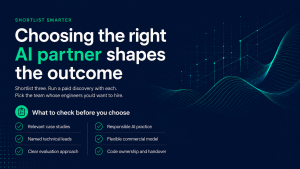
Use the following filter before shortlisting:
Case studies that look like you:
Same industry, similar data estate, comparable regulatory pressure.
Named engineers, not just logos:
Ask who will actually build. Insist on CVs for the lead ML engineer, the platform lead, and the delivery lead.
A working point of view on evaluation:
If a firm cannot explain how it measures model quality and grounds hallucinations, walk away.
Responsible AI practice:
You can look for alignment with the EU AI Act, ISO/IEC 42001, and the NIST AI Risk Management Framework.
Commercial flexibility:
Fixed price discovery, time and materials build, outcome-based run. Rigid commercial models tend to hide weak delivery.
A clear exit:
Code ownership, documentation standards, and knowledge transfer written into the contract.
Choose a partner that can explain both results and lessons learned.
How long does custom AI software development take?
Timelines are shorter than they were two years ago, thanks to better foundation models and mature tooling. Typical ranges for UK enterprise programmes:
Discovery and proof of value:
4 to 8 weeks
First production release of a focused use case:
3 to 5 months
Multi-model platform with governance:
6 to 12 months
Enterprise-wide AI programme:
12 to 24 months, run as a rolling portfolio
The largest variable is not the model. It’s data readiness, security review, and integration with the systems the AI needs to touch. Firms that outsource AI development services successfully treat data engineering as the first workstream, not an afterthought.
Final Thoughts
Choosing an AI development partner in 2026 is less about finding the biggest name and more about finding the right fit. Budgets are tighter, boards are asking harder questions, and the gap between AI spend and AI value is now impossible to ignore. The eight firms above give UK enterprise buyers a credible starting point, but the real work begins with how you evaluate them.