Every progressing organization reaches a point where the software question becomes inevitable. Your current systems are not interacting with each other. Tactical measures are consuming hours your team cannot afford. A vendor is promising that their platform solves everything. We will be discussing the system integration services in this blog and explaining them in detail.
Choosing between custom incorporation and off-the-shelf software is a strategic business decision. The appropriate choice forces growth, while the wrong one increases long-term costs and challenges. Let’s discuss a defined plan for making that decision based on your actual business needs in this blog.
What Is the Difference Between Custom and Off-the-Shelf Software?
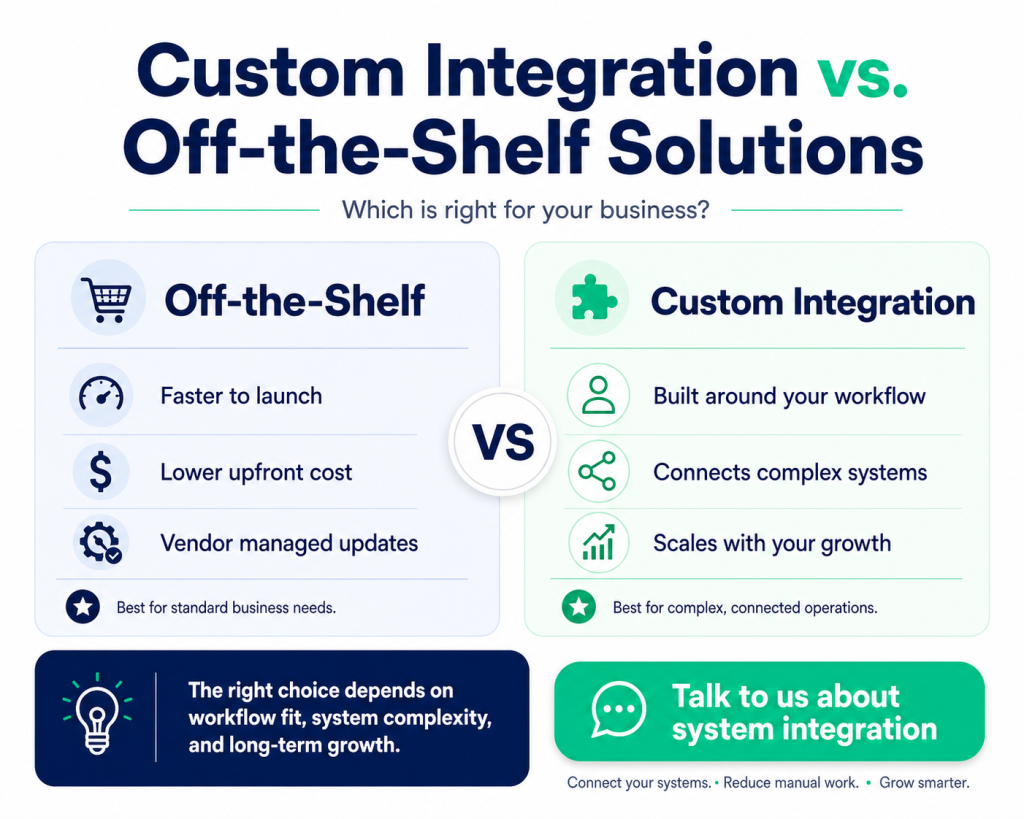
Off-the-shelf software is a ready-made software that is designed to serve a wide market. This software ships with standard features that cover common use cases, transfers quickly, and mostly costs less upfront such as Think Salesforce, QuickBooks, HubSpot, or SAP.
Custom incorporation and software are built for your business. They match your task, data, compliance, and operational needs.
Nothing is generic. Everything is intentional. Neither approach is universally better: The right choice depends on how well standard software fits your needs.
When Off-the-Shelf Software Makes Sense
Off-the-shelf software retains its place in the appropriate circumstances. For standard functions, off-the-shelf software is often enough. These tools are mature and far more cost-effective than building from the start.
The case for packaged solutions is strongest when:
- Your processes are genuinely standard and do not require personalization.
- You need to transfer quickly and cannot wait for a custom build timeline.
- Your budget is limited, and the functional fit is close enough.
- The vendor’s development strategy matches where your business is heading.
- The software category is well-established with proven vendors.
- Off-the-shelf software includes vendor updates, community support, and ready-made incorporations.
When Custom System Integration Services Are the Better Choice?
Custom software makes sense when standard tools no longer fit.
The case for custom system integration is strongest when:
Your workflows are genuinely unique
If your processes are highly specialized, standard software may not fit. It forces your business to adapt to the software. This is common in manufacturing, finance, and regulated industries. In an off the shelf vs bespoke software comparison, bespoke software does the opposite.
You need systems to work together seamlessly
Many businesses use multiple disconnected platforms. These systems do not communicate naturally. System integration services connect to your systems. They move and transform data, so every tool uses the same information. Custom integration automates workflows. It removes manual data entry between disconnected systems.
Data migration and integrity are critical
Legacy data migration requires careful validation. Top system integration providers manage data migration with precision. This helps protect the accuracy and reliability of critical business records.
Scalability is a priority
Off-the-shelf platforms scale with vendor limits, and costs often rise as your business grows. Custom development scales on your terms with only the features you need.
Digital transformation is more than adopting technology. It reshapes how a business operates and grows. Restructuring often needs custom software beyond pre-built platforms.
The Real Cost Comparison
Upfront costs usually favor off-the-shelf software over custom development. That comparison is incomplete.
The full cost picture includes:
Off-the-shelf software costs:
These costs rise with the number of users, features, and data volume. Enterprise software from major vendors can cost businesses hundreds of thousands each year.
Customization costs within packaged platforms:
Most businesses customize off-the-shelf software extensively. These costs often exceed custom solution expenses within a few years.
The cost of workarounds:
Poor software fit creates workarounds and costly errors. These costs are real but rarely appear in software budget comparisons.
Integration of failure costs:
Incompatible platforms often create unreliable integrations. Top integration providers build stable, reliable connections.
Custom integration services often provide better long-term value for complex businesses.
Types of Business Software Solutions: A Practical Decision Framework
Choosing business software starts with four key questions. These questions help identify the best solution for your needs.
How closely does the standard software fit your actual workflow automation process?
If the fit requires significant adaptation of your processes to the software, the software is wrong for you, not the other way around.
How many systems need to connect, and how critical is that connectivity?
The more systems and data flow you have, the more custom integration makes sense. Pre-built connectors often cannot handle complex requirements.
What is your three-to-five-year growth trajectory?
Off-the-shelf software that fits today may constrain you as you grow. Modular custom software grows with your business. It adapts over time without needing a full replacement.
What are your compliance and security requirements?
Highly regulated industries often need custom software. It helps meet compliance without limiting operations.
Can Custom Software Integrate with Existing Systems?
Can custom software integrate with existing systems? Yes, and this is one of its primary advantages over off-the-shelf alternatives.
Well-designed custom system integration is built around your existing technology environment. Rather than replacing what is working, it connects and enhances it. Modern integration uses APIs, middleware, and event-driven flows. It connects legacy systems, cloud platforms, and custom applications.
The result is a fully connected technology environment. All systems work together as part of a unified architecture.
Why Do Businesses Choose Custom Software Over Ready-Made Solutions?
Why do businesses choose custom software over ready-made solutions? Various businesses such as aiimone provide system integration services to their clients. The reasons are consistent across industries and business sizes:
- They have outgrown what packaged software was designed to handle.
- Their competitive differentiation depends on processes that packaged software cannot support.
- The accumulated cost of workarounds and manual processes has become unsustainable.
- Previous off-the-shelf implementations failed to deliver the expected value.
- They need a reliable system of integration that vendor-provided connectors cannot deliver.
Businesses often realize they should adopt custom integration sooner. Off-the-shelf tools looked cheaper upfront but cost more over time.
Final Remarks
In conclusion, the custom vs. off-the-shelf software comparison has no appropriate answer. The best choice depends on your requirements, combination of complexity, and growth plans. Compare the total cost over several years, not just the upfront price. In 2026, fragmented systems create growing costs. They lead to manual work, slow decisions, and limited growth. System integration services connect disconnected systems as they reduce inefficiencies and support business growth. The question is not whether to close it. It is the approach that closes it most effectively for your specific situation.