
Every business today generates more data than it can use. The gap is not in data volume; it is in the infrastructure that moves, cleans, and delivers that data to the people and systems that need it.
That gap makes data engineering services a key investment. It has become essential for modern businesses in 2026. Not because it is trending. Because the cost of operating without a reliable data infrastructure has become too high to defer any longer. Let’s discuss in this blog the reason for businesses nowadays invest in data engineering services.
Why is Data Engineering Important in 2026?
Data engineering matters for one key reason. All data use cases depend on a reliable data foundation. Without proper pipelines, data becomes unreliable. It arrives late, is inconsistent, or may not arrive at all. Dashboards show stale numbers. Machine learning models train on dirty data. Business decisions get made on information nobody fully trusts.
Data engineering builds systems to move and manage data. It ensures that data is clean, reliable, and ready for use.
Why Are Businesses Investing in Data Engineering Services?
Why are businesses investing in data architecture services at an accelerating rate in 2026? Four forces are driving the investment simultaneously.
AI Adoption Demands Clean, Reliable Data Pipelines
AI results depend on data quality. Poor data leads to poor model performance. Models trained on poor data give poor results. Inconsistent or incomplete data leads to unreliable outputs. And unreliable outputs get ignored or worse or are acted on incorrectly.
Strong data pipelines and workflows are essential for AI to work. Without them, production AI fails to deliver. Businesses that invest in data engineering early see results faster. It helps AI projects deliver usable outcomes sooner. Businesses that skip this step rebuild their data infrastructure after the AI project fails.
Real-Time Decisions Require Real-Time Data
Batch processing that updates data daily was acceptable five years ago. In 2026, businesses need live data. It supports better customer experience and faster decisions.
Modern cloud platforms enable real-time data processing. Amazon Web Services, Microsoft Azure, and Google Cloud make it affordable and accessible. Technology is mature. The barrier is no longer technical capability. It is whether the business has an engineering foundation to use it.
Data Sprawl Has Reached a Breaking Point
Most mid-market businesses use many SaaS apps. Each creates data in different formats, locations, and update cycles. Without proper data architecture, sources stay disconnected. Teams end up working with different versions of reality.
Fragmented data leads to wasted effort and conflicting reports. The cost has grown too high for businesses to ignore. Enterprise data engineering can be a turning point. It helps clear years of built-up data debt.
Regulatory Pressure Is Tightening
Businesses face growing pressure to prove data control. This applies across standards like HIPAA, GDPR, and CCPA. Data quality and governance need a strong data foundation. Without it, tracking and controlling data is not possible.
Benefits of Data Engineering for Modern Businesses
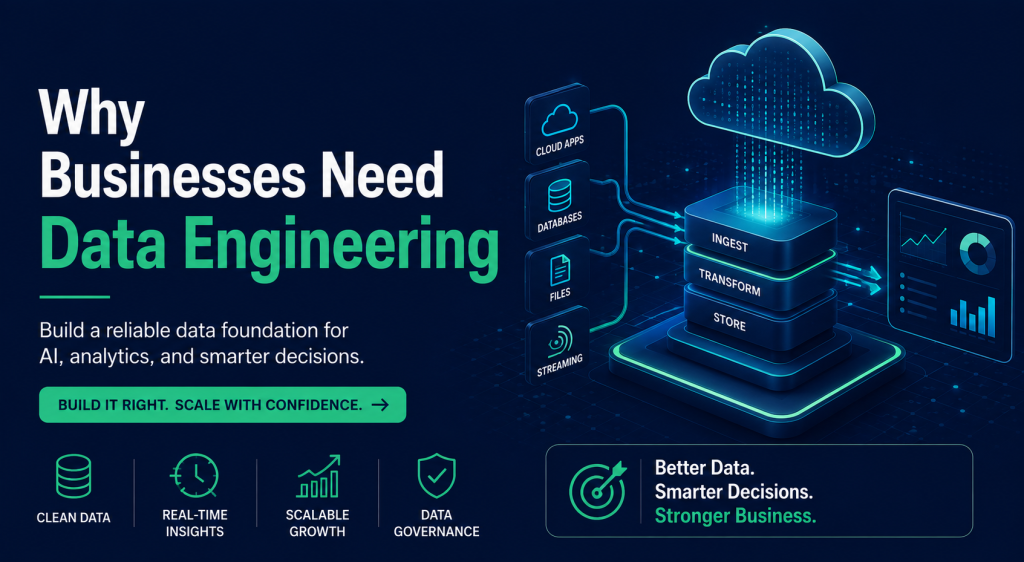
Data engineering benefits every part of the business. In 2026, all functions rely on data.
Reliable data improves decisions:
It makes them faster and more accurate. Teams spend less time questioning the numbers and more time acting on them.
Lower operational cost:
Manual data work is costly and slow. It also increases the risk of errors. Data engineering automates these tasks. It cuts costs and reduces errors.
Scalable analytics capability:
A strong data architecture supports growth. It handles new data and higher volumes without major rebuilding. Without a solid foundation, systems break under growth. Teams end up rebuilding when they should be scaling.
AI and machine learning readiness:
Clean, governed, well-structured data is the input that makes AI investments pay off. Good data pipelines make AI reliable. Clean, structured data helps models perform well in production.
Best Data Engineering Solutions for Scalable Pipelines
Top solutions use cloud-native infrastructure with modern tools. They support the full data lifecycle at scale. Modern stacks use tools like Snowflake or Databricks for storage and computing. They merge tools like dbt, Airflow, and Kafka for transformation, orchestration, and streaming. Cloud platforms offer managed services that cut operational effort. Amazon Web Services, Microsoft Azure, and Google Cloud reduce overhead.
The right setup depends on your needs. Data size, speed, team skills, and current cloud setup all matter. This is where experienced providers make a difference. They customize the tech to your business requirements.
Do Small Businesses Need Data Engineering Services?
The honest answer is it depends on where the data gaps are costing you the most.
Small businesses often face hidden data issues. Outdated reports and poor visibility lead to lost opportunities. Cloud data engineering is now accessible to small businesses. Modern infrastructure no longer requires large-scale investment. Managed services on AWS, Azure, and GCP eliminate the need for large infrastructure teams. Modular approaches let small businesses start with key problems. They can expand their data setup step by step over time.
Right-sized cloud data engineering solutions give small businesses the same core value as enterprises. Reliable, accurate data reaches the right people and tools.
How to Choose the Right Data Engineering Service Provider?
Choosing the right provider takes more than tech skills. You need to assess multiple factors beyond capability. Various companies such as aiimone provide data engineering services to their clients.
Cloud platform expertise:
Each cloud platform works differently. Amazon Web Services, Microsoft Azure, and Google Cloud vary in pricing, services, and combinations. Your provider needs current expertise with the platform your organization uses.
Modern stack depth:
You can look for experience with modern data tools. This includes DBT, Airflow, Prefect, Snowflake, Databricks, and Kafka. Providers using legacy tools may not meet your needs. They can struggle to support future growth.
Governance-first approach:
The best data engineering service providers build data quality and governance into the framework from day one. Ask specifically how they approach lineage tracking, quality validation, and access controls during implementation.
Outcomes over tools:
The strongest providers lead with business outcomes of what decisions will be faster, what costs will be lower, and what AI initiatives will now be possible, rather than technology lists and architecture diagrams.
Final Remarks
Data engineering services are not a back-office technical investment. They are the operational foundation that determines whether every other data initiative your business pursues delivers its potential or falls short because the data beneath it was never reliable enough to act on.
The businesses investing in enterprise data engineering in 2026 are not doing so because it is fashionable. They are doing so because their competitors already have, and because operating without a reliable data infrastructure has become a competitive disadvantage; they can no longer afford it. The data your business generates every day has real value. Data engineering is how you unlock it.