Dubai has spent the last decade turning innovative concepts into working infrastructure. Dubai introduced its blockchain strategy in 2016. D33 aims to double the economy by 2033. Web3 blockchain is a key pillar of this strategy. Banks, logistics firms, healthcare providers, and governments face one question.
This guide covers modern Web3 development services. It explains MENA use cases and how to choose the right Web3 partner. Expect straight answers, current figures, and a practical comparison you can share with your board.
What are Web3 development services?
Web3 development delivers secure applications powered by blockchain. The scope includes architecture, smart contracts, wallets, integration, security, and ongoing support.
A serious Web3 software development engagement is not an iteration. This starts from the business case to production with clear service levels. Blockchain delivers the greatest value when integrated with enterprise systems.
Web3 vs blockchain: what is the difference?
Blockchain is the foundation of decentralized systems. Records transactions across distributed nodes using cryptography. Web3 gives users ownership of data, assets, and identity. It uses smart contracts to automate secure digital transactions.
Every Web3 app uses blockchain. Not every blockchain project is Web3. Enterprise blockchains use permissioned networks for secure access. A public marketplace where anyone can mint, trade, or verify a digital asset is Web3. Dubai businesses combine permissioned and public blockchains for different use cases.
Core Web3 blockchain development services
Most enterprise blockchain projects share the same core capabilities. The mix depends on the industry and the maturity of the internal engineering team.
- Blockchain architecture across Ethereum, Layer 2, and Hyperledger. Support for Polygon, Solana, and permissioned networks.
- Personalized blockchain development for new chains, sidechains, and optimistic rollups.
- Smart contracts in Solidity, Rust, and Move with security audits.
- Ethereum development for ERC-20, ERC-721, ERC-1155, and gasless transactions.
- Blockchain integration with existing systems like ERP, CRM, core banking, and identity providers.
- Web3 ecosystem development covering wallets, dApp front ends, node infrastructure, and analytics.
- Blockchain software development for tokenization of real-world assets, loyalty, and supply chain traceability.
- Web3 consulting services for regulatory alignment, tokenomics, governance, and go-to-market.
Why the UAE and MENA are moving fast?
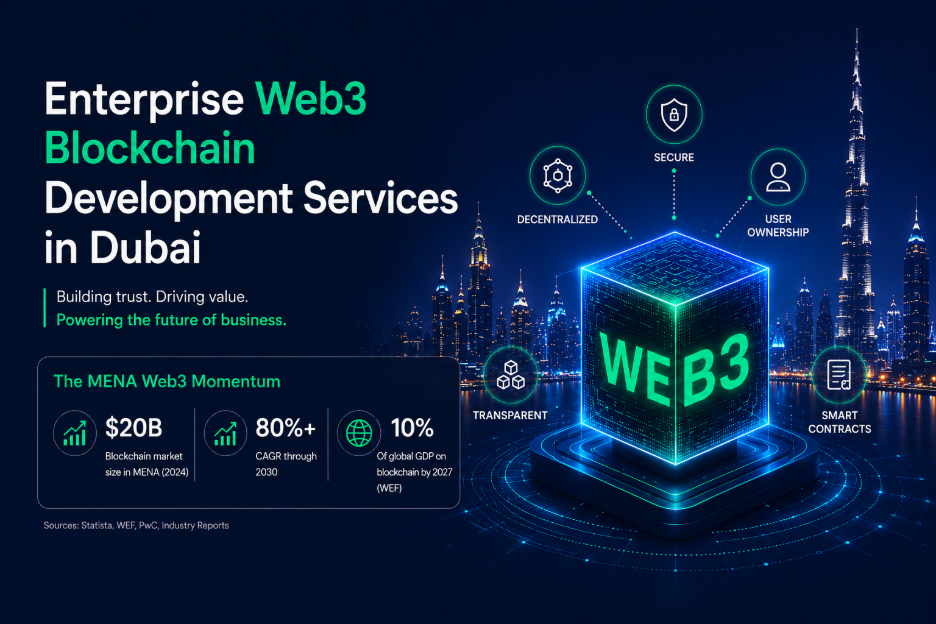
The numbers show where the region is heading. The blockchain market reached USD 20 billion in 2024 and is expected to grow at 80%+ CAGR through 2030. The World Economic Forum estimates up to 10% of global GDP will be on blockchain by 2027. The UAE advances the Digital Dirham, and Saudi Vision 2030 supports blockchain.
Over 75% of executives prioritize digital assets. MENA enterprises use blockchain across finance, logistics, and government.
Traditional systems, enterprise blockchain, and Web3 compared
Boards often ask why blockchain is needed at all. This comparison helps frame the choice.
| Attribute | Traditional Web/DB Systems | Enterprise Blockchain | Web3 (Decentralized Apps) |
| Data control | Single owner or vendor | Consortium of permissioned parties | Distributed across a public network |
| Trust model | Trust the operator | Trust shared rules and validators | Trust code, cryptography, and consensus |
| Typical latency | Milliseconds | Seconds | Seconds to minutes depending on chain |
| Auditability | Depends on internal logs | Built into the ledger | Public and verifiable on-chain |
| Best fit | Internal apps, CRMs, portals | Cross-bank settlement, supply chain | Tokenization, DeFi, digital identity |
| Regulatory posture | Well understood | Fits most enterprise compliance needs | Evolving, requires legal review |
How long does it take to build a blockchain application?
An achievable scope for a first production release is 4 to 9 months. A simple token or NFT drop with a standard smart contract can go live in 6 to 8 weeks. Enterprise blockchain platforms take 6–12 months. Regulated projects may require longer.
Delivery depends on integrations, security reviews, and regulatory approvals. Early threat modeling and two smart contract audits reduce redo and speed delivery.
Secure Web3 application development
Security is the main reason Web3 projects publicly fail. Crypto losses reached USD 2.2B in 2024 due to security failures.
Secure Web3 development starts with threat modeling and secure coding. It includes audits, verification, and continuous tracking after initiation. Store keys in HSMs or MPC systems, never on developer laptops.
Scalability without shortcuts
Public chains have grown. Ethereum Layer 2 networks now outperform the base layer. Dencun reduced transaction fees by over 90%. For enterprises, this means real-world throughput is finally within reach. A payments pilot that cost dirhams per transaction two years ago can now settle for portions of a fil.
Enterprise blockchain implementation should still model peak load, and not average load. Enterprise blockchain platforms handle millions of daily events. Choose the right blockchain architecture based on data.
How to choose a Web3 development company
Dubai has no shortage of vendors claiming blockchain expertise. A practical checklist helps identify the right partner.
- Verifiable production references in your industry, not just testnet demos.
- In-house auditors, or clear partnerships with recognized audit firms.
- Comfort with both public chains and permissioned frameworks.
- A track record of blockchain integration with existing systems.
- Local presence, awareness of UAE PDPL, VARA guidance, and Saudi CST rules.
- Willingness to co-own the plan, including operations after go-live.
A 4–6 week discovery is usually enough to validate fit. Discovery should deliver a technical plan, security strategy, and business case. Aiimone delivers Web3 consulting across the UAE and MENA. From strategy to secure, production-ready Web3 applications.
Closing thoughts
Dubai and MENA use blockchain to cut costs and build trust. Success comes from strong engineering, clear governance, and commercial focus. That is the standard enterprise Web3 blockchain development services should be held to. Logistics operators are proving provenance without swapping paper certificates across three time zones. Government departments are issuing verifiable credentials that citizens control. None of this is theoretical anymore.
The organizations that pull ahead over the next three years will share a few habits. They treat Web3 as a business program, not a technology experiment. They put a named executive sponsor behind every use case, with clear KPIs and a real budget. Partner with a Web3 development company with proven production experience. Security is built in from day one, with continuous audits.