Agentic AI Systems Architecture Services for Enterprise Automation in Dubai
Enterprise leaders in Dubai are moving past pilot projects. They want AI that acts, and not just answers. Agentic AI systems architecture is the design layer which makes this possible. It gives self-governing agents the structure to plan tasks, call tools, handle data, and finish work with limited human input.
This guide explains what agentic AI architecture is, how it drives enterprise automation services, and what UAE businesses should measure before they invest.
What is Agentic AI Architecture?
Agentic AI architecture is a comprehensive plan that lets AI agents operate on their own inside an enterprise environment. Traditional AI models respond to prompts. Agentic systems set goals, choose actions, use tools, and adapt based on results.
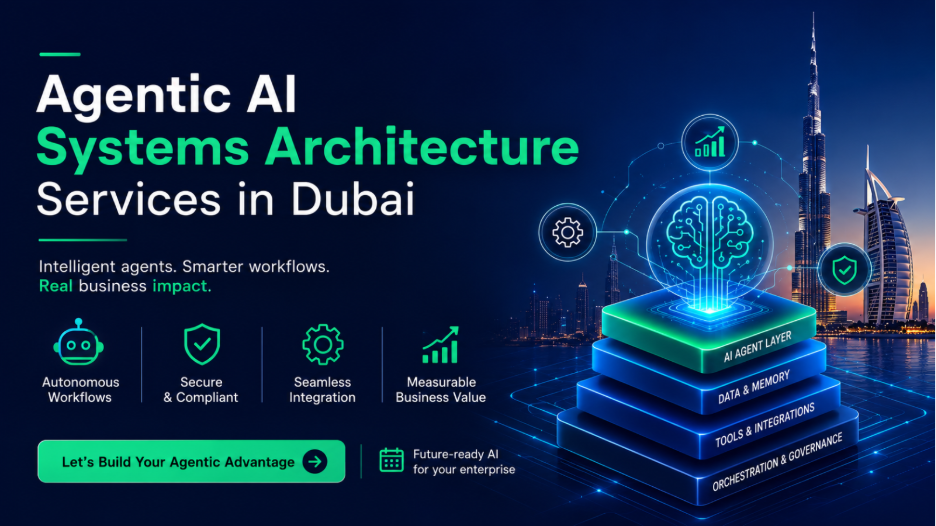
The structure usually includes four layers. A reasoning layer powered by large language models. A memory layer that stores context across sessions. A tool layer that connects agents to APIs, databases, and applications. And an orchestration layer that manages multi agent coordination and guardrails.
Together, these layers form an AI agent framework that can handle real business tasks. Think about procurement approvals, customer support triage, financial reconciliation, or supply chain monitoring. This is the practical face of AI systems architecture inside a working enterprise.
Why are Dubai Enterprises investing in enterprise AI Architecture?
The UAE’s D33 economic agenda and the wider Vision 2030 push across the GCC have made AI adoption a national priority. The UAE has appointed a Minister of State for Artificial Intelligence and set out a national AI strategy that targets sector wide adoption by 2031. That kind of target does not get hit by chatbots alone. It needs enterprise AI infrastructure that can automate real workflows at a scale.
Banks in DIFC, logistics operators near Jebel Ali, healthcare groups across the Emirates, and retail chains in the malls all face the same pressure. They need to cut manual work, respond faster, and stay compliant with the UAE Personal Data Protection Law. Agentic AI gives them a path.
For decision makers, the shift is strategic. AI stops being a set of point tools and becomes part of the operating model. That is why boards are asking for a plan, not proof of concept.
Core Components of Enterprise AI Architecture Services
A working enterprise with AI architecture is more than a model and an API key. It brings together several building blocks that need to fit each other.
Data foundation:
Agents need clean, governed data. That involves pipelines, a Lakehouse or warehouse, vector stores for retrieval, and data quality checks.
Model layer:
Most enterprises mix commercial models with open weight options. The architecture should let teams swap models without rewriting the whole stack.
Agent at runtime:
This is where agents actually run. It handles prompts, tool calls, retries, and cost tracking.
Integration fabric:
Agents are only useful when they can touch real systems. That means connectors to ERP, CRM, ITSM, HR platforms, and custom applications. This is where AI integration services usually take a great time, especially in older enterprises with legacy stacks.
Observability and evaluation:
You cannot ship what you cannot measure. Logging, tracing, evaluation of harnesses, and human review queues all belong to the design.
Security and governance:
Zero trust access, prompt injection defenses, data masking, and audit trails belong in the architecture from day one and not tracked later.
How Can Agentic AI Automate Business Processes?
Autonomous workflow automation works by breaking a business process into smaller decisions and actions, then handing each one to the right agent or tool.
Take a claims process at an insurance firm. A single agent can read the claim, pull policy data, check fraud signals, request missing documents, and route the case to a human only when it hits a threshold. What used to take days can close in minutes.
Retail teams use agents to watch inventory, forecast demand around Ramadan and back to school peaks, and adjust pricing. Government service centers use them to draft responses in Arabic and English, saving staff hours every week. Banks use them to speed up KYC review while keeping a human in the loop for edge cases.
The pattern is consistent. AI powered business automation works best when the architecture supports memory, tool use, and clear handoffs to people. Skip any of those, and the agent becomes a demo, not a service.
Implementation Approach for Enterprise Agentic AI Implementation Services
Most successful rollouts follow a similar path. It rarely helps to start with the most complex use case.
Step one is discovery. Map the processes that are high volume, heavy, and painful. These are the best candidates for AI architecture consulting for business automation.
Step two is architecture design. Pick the model strategy, the agent runtime, the integration approach, and the security control. Decide what runs in a UAE data center and what runs abroad. For regulated sectors, residency often decides the whole design.
Step three is a focused pilot. Ship one workflow from end to end. Measure accuracy, cost per task, and human override rate. Do not skip evaluation.
Step four is scaled. Reuse the same architecture across other processes. This is where the value compounds and where custom AI architecture services pay for themselves.
Step five is operations. Set up a small team that owns models, prompts, evaluations, and incident responses. Treat agents like any other production system.
AI Architecture for Digital Transformation
Digital transformation in the UAE has moved past dashboards and mobile apps. The next wave is about work getting done without a person clicking through screens. AI architecture for digital transformation ties agentic systems into the operating model. HR, finance, operations, and customer experience all become candidates for autonomous or semi-autonomous flows.
The businesses that will lead are the ones that treat their AI stack as a main infrastructure, like how they treat their cloud or their network. That means budget, ownership, and plans, and not one-off projects.
How Much Does Enterprise AI Architecture Cost?
The honest answer is that it depends on the scope. A single agent pilot with one integration and moderate volume can start in the low tens of thousands of dollars. A full enterprise rollout across various business units, with data engineering, integration work, security review, and change management, can run into the millions.
Cost drivers usually include the number and complexity of tasks automated, the volume of tokens processed each month, the integration count and the state of source systems, data cleanup and readiness work, compliance and residency requirements, and ongoing evaluation and monitoring.
A useful rule for boards in the region. Expect the first year to be heavier on setup. The following years shift toward running and expanding costs. Most of the long-term value shows up in years two and three, once the architecture is reused across processes.
Security, Compliance, and Trust
Enterprise buyers in the UAE and KSA care about three things beyond accuracy, such as data residency, access control, and auditability. Any custom AI architecture services offer should address all three from the first conversation.
Zero trust principles apply to agents as much as to users. Every tool call should be authenticated, authorized, and logged. Sensitive fields should be masked before they reach a model. Prompt injection and data exfiltration need active defenses, and not just policies on paper.
The National Cybersecurity Authority in Saudi Arabia and the UAE Cyber Security Council both expect this level of rigor from regulated firms. Boards and audit committees will ask about it.
Choosing a Partner for Enterprise Agentic AI Implementation Services
Selection usually comes down to three questions. Can the partner design an architecture that fits your regulatory context? Do they have working reference implementations, not just slide decks? Will they hand over documentation and skills so your team can own the system later?
Aiimone works with enterprises across the UAE and wider MENA region on agentic AI systems architecture, from discovery through production support.
Closing Thoughts
Agentic AI systems architecture is not a product you buy. It is a structure you design, run, and improve. For Dubai enterprises aiming to lead the next phase of digital transformation, getting that architecture right is what separates a demo from real enterprise automation services.
The organizations that pull ahead in the next two years will not be the ones with the most models or the biggest AI budgets. They will be the ones that treat agentic systems as production infrastructure. That means clear ownership, funded roadmaps, measurable service levels, and a security posture that holds up to a regulator’s visit. It also means a culture shift. Teams stop asking whether AI can help with a task and start asking which agent owns it, what data it uses, and how its work gets reviewed.