







AIIM ONE

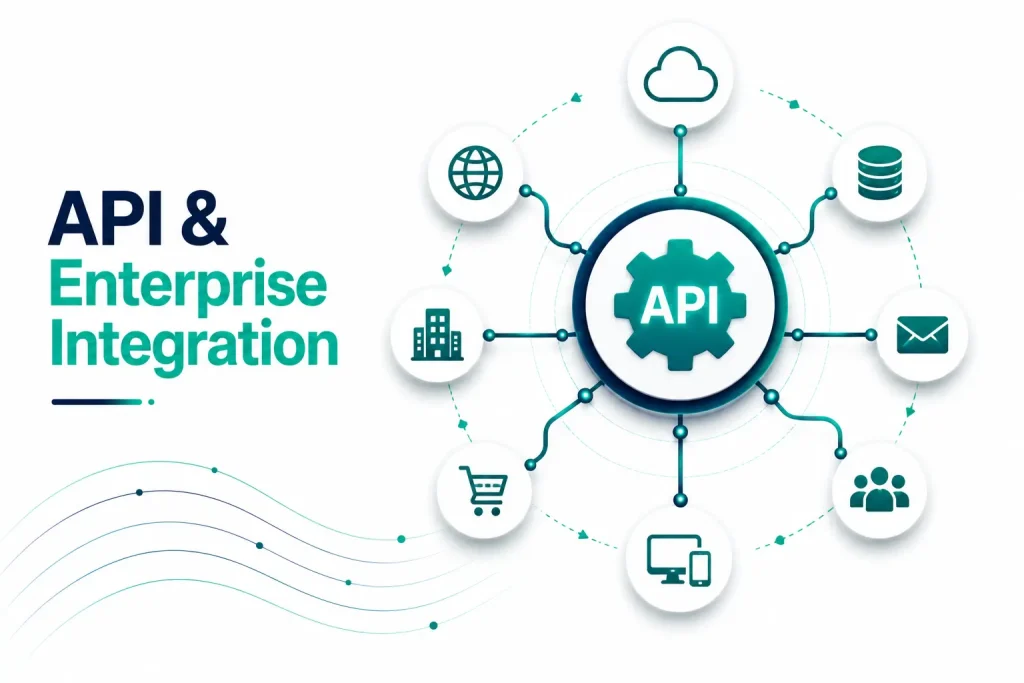
API & Enterprise Integration

Table of Contents
API & Enterprise Integration

API & Enterprise Integration

Disconnected systems, manual data entry, and data inconsistency issues are operational problems that compound over time. Every gap between your platforms slows decisions, creates errors, and adds work your teams shouldn’t be doing. AiimOne delivers enterprise API integration services that connect your applications, platforms, and data sources into a unified, automated ecosystem. From REST API integration and third-party API integration to legacy system API integration and microservices API integration, we build secure, scalable connections that keep your business running without the friction.

Trusted by Top Companies

API & Enterprise Integration Services We Offer

01

Custom API Development and Integration

We design and build custom APIs and integration layers that connect your internal systems and third-party platforms cleanly and reliably. From cloud API integration to B2B API integration and full API management, we engineer every connection for performance, security, and long-term maintainability.

02

Enterprise and Legacy System Integration

We specialize in legacy system API integration that brings older systems into your modern data flows without replacing them prematurely. Using middleware solutions and API orchestration services, we bridge the gap between old and new infrastructure reliably.

03

Microservices and Cloud API Integration

We build microservices and cloud API integration solutions that handle real-time data exchange and keep distributed systems in sync. Our builds run on AWS API Gateway, Azure API Management, Apigee, and Kong for scalable and robust API connectivity.

04

API Security Authentication and Management

We implement API security best practices including authentication, authorization, rate limiting, and monitoring across all integration layers. Every API we build is designed to prevent integration of errors, security issues, and unauthorized data access from day one.

API & Enterprise Integration

01

Integration Discovery and System Mapping

We audit your current systems, data flows, and integration gaps, identify disconnected systems and manual processes, and define a clear integration architecture before any development begins.

02

API Architecture and Design

Our engineers design the integration layer, select the right tools and platforms, and plan authentication, data transformation, and error handling to ensure every connection is reliable and secure.

03

Development Testing and Deployment

We build and thoroughly test every API integration against real data scenarios, then deploy into your production environment with minimal disruption, full documentation, and ongoing technical support.

04

Monitoring and Optimization

We set up API monitoring and alerting from day one, track performance and error rates, and continuously optimize integrations as your systems and data volumes evolve, ensuring long-term reliability and scalability.

Why Choose AIIM ONE?

We Connect What Others Call Too Complex

Legacy Systems, Custom Platforms, Niche Third-party tools. We’ve integrated them all. If your systems need to talk to each other, we find a way to make it work reliably.

APISecurity and authentication aren’t optional extras in our process. Every integration we deliver is built with access controls, encryption, and monitoring in place from the start.

We work across MuleSoft, Boomi, Workato, Zapier, AWS, Azure, and custom-built solutions. We recommend what fits your architecture, not what we prefer to sell.

We build scalable API integration solutions that handle growing data volumes, new system additions, and evolving workflows without requiring a full rebuild every time something changes.

Case Study

App Development Case Study

Testimonials

Client Testimonials

Frequently Asked Question

What is API integration?

API integration is the process of connecting two or more software systems, so they can share data and functionality automatically.

APIs expose functions or data from one system that another can request and use. An integration layer handles communication, transforming data formats, managing authentication, and routing requests, so information flows accurately between platforms in real time or on a schedule.

Common tools include AWS API Gateway and Azure API Management for cloud-native integrations, MuleSoft and Boomi for enterprise platforms, Apigee and Kong for API management, Workato and Zapier for automation workflows, and Postman and Swagger for testing and documentation. 

Cost depends on the number of systems being connected, data transformation complexity, and whether you need custom development or platform configuration.

We work across fintech, healthcare (HL7 and FHIR), ecommerce, logistics, insurance, retail, SaaS, and manufacturing ERP systems.

AiimOne works with businesses globally, delivering API integration and enterprise connectivity services remotely across the US, UK, UAE, Australia, and beyond.

Build a Connected Business Without the Complexity

Share the Post:
FAQ

Frequently Asked Question

How does Nucleus-One integrate with existing applications?

Nucleus-One connects via our robust API and pre-built connectors. Enterprise customers also get custom integration services for any proprietary or legacy system.

Common mistakes include keyword stuffing, neglecting mobile optimization, ignoring technical SEO, using duplicate content, not optimizing for local search, and failing to monitor and analyze SEO performance.

Common mistakes include keyword stuffing, neglecting mobile optimization, ignoring technical SEO, using duplicate content, not optimizing for local search, and failing to monitor and analyze SEO performance.

Common mistakes include keyword stuffing, neglecting mobile optimization, ignoring technical SEO, using duplicate content, not optimizing for local search, and failing to monitor and analyze SEO performance.

Common mistakes include keyword stuffing, neglecting mobile optimization, ignoring technical SEO, using duplicate content, not optimizing for local search, and failing to monitor and analyze SEO performance.

Common mistakes include keyword stuffing, neglecting mobile optimization, ignoring technical SEO, using duplicate content, not optimizing for local search, and failing to monitor and analyze SEO performance.