
How AiimOne Rebuilt Echo One Into an Audit-Ready Multi-Tenant SaaS in 7.5 Weeks
Industry
Transportation
Service
Custom Software Development
Tech Stacks
AWS, PostgreSQL, Claude Code
Executive Summary
AiimOne rebuilt Echo One’s NEMT platform from the ground up as an audit-ready multi-tenant SaaS, using Claude Code to power its agentic development workflow. The approach cut the platform-gap rebuild effort by up to 48% and compressed spec-authoring from a week to overnight.
Echo One came to AiimOne after their no-code V1 platform hit a wall. They’d grown 12x in 18 months, but the system couldn’t support multi-tenancy, HIPAA and NIST 800-53 compliance, or the state-agency audits their government contracts required.
AiimOne rebuilt the platform on AWS with Postgres Row-Level Security for true tenant isolation. Claude Code drove the mechanical work through a council-based multi-agent workflow, while humans stayed locked to anything touching auth, PHI, or tenant boundaries. The result is a SaaS platform ready to onboard additional NEMT providers while keeping Echo One’s 24/7 dispatch operations running clean.

Key Results:
- 44 to 48% reduction in the platform-gap rebuild effort (from 257-409 hours down to 145-238 hours)
- 1.4x to 1.6x engineering-hour multiplier on ~35% of the work through Claude Code-assisted development
- Spec-authoring compressed from a full week to overnight using parallel Claude Code subagents
- Planned AWS services simplified from 19 to 13 through architecture council reviews
- Auth stack reduced from 3 systems to 2
- 2,239 commits shipped across the build (Feb to Jul 2026)
- 16 buy / 13 build decisions locked in early, focusing team effort on NEMT domain logic and tenant isolation
What Was Breaking the V1 Platform?
12x Growth Hit a No-Code Wall That Government Auditors Wouldn’t Accept
Echo One’s V1 platform couldn’t support multi-tenancy, referential integrity, or the compliance posture their state Medicaid contracts required. Growth had outrun the tooling.
The V1 was built on Backendless, a no-code platform. That choice got Echo One off the ground, but as they scaled to 10,000+ rides a month across three states, cracks turned into structural problems.
The key challenges are:
- Opaque API references could leave orphaned records behind
- The data layer had no tenant separation for true multi-tenant support
- Critical data such as money coordinates and IDs were stored as strings
- Social Security numbers were stored in plain text
- Proprietary minified JavaScript made existing pages impossible to port
- Every form had to be manually reviewed and rebuilt
- Export limitations made moving the complete application difficult
- Key dispatch queries took 2 to 3 minutes instead of under 2 seconds
- Around 255 to 410 hours of built-in platform features had to be recreated from scratch
Echo One needed a real platform, not a patched one.

Goals and Objectives
Build a Multi-Tenant SaaS That Passes State CISO Audits
Echo One wanted a HIPAA and NIST 800- 53-compliant multi-tenant platform ready for white-label expansion while keeping real-time dispatch performance under 200ms.
The full goal set:
- Build for multi-tenancy from day one to support a scalable SaaS model
- Meet HIPAA and NIST 800-53 requirements with strong security and compliance
- Keep real-time dispatch performance below 200ms
- Support white label expansion across 5 to 20 tenants
- Target $125K ACV per tenant
- Prioritize faster delivery with a simple and practical architecture
- Keep the platform manageable for a 5-person team
- Use proven off-the-shelf solutions wherever possible instead of building everything from scratch
How Do You Rebuild a Live 24/7 NEMT Platform Without Breaking Dispatch?
AI Handles the Heavy Work; Humans Handle the Sensitive
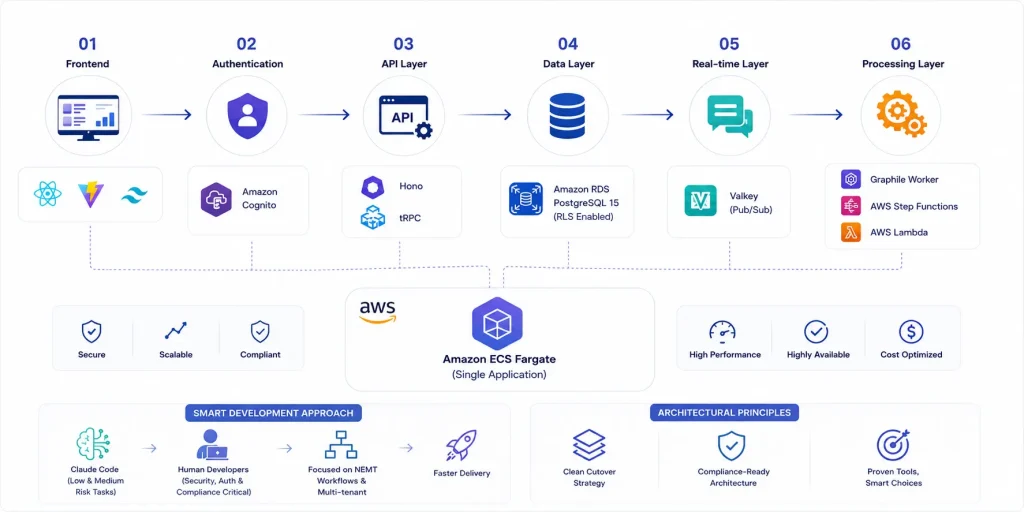
- Built a single AWS ECS Fargate application with React 19, Vite, Hono, and tRPC.
- Used Amazon RDS PostgreSQL 15 with Row-Level Security (RLS) for multi-tenant data isolation.
- Implemented Amazon Cognito for secure authentication.
- Used Valkey for real-time messaging and pub/sub.
- Leveraged Graphile Worker, AWS Step Functions, and AWS Lambda for asynchronous and batch processing.
- Built the frontend with Tailwind CSS, Untitled UI, AG Grid, SurveyJS, and Mapbox.
- Focused custom development on NEMT workflows and multi-tenant architecture while using proven third-party tools elsewhere.
- Accelerated development with Claude Code for low- and medium-risk tasks.
- Reserved security, authentication, and compliance-critical code for human developers.
- Chose a clean cutover strategy instead of dual-write or strangler migrations.
- Selected a simple, compliance-ready architecture over more complex alternatives.
7.5-Week Weekly Scaffold With 7 Gates, Three Pods, and a Council-Based Claude Code Spec Workflow
Organized the project into three pods: Backend, Full-Stack Frontend, and Program, Quality & Customer Success, all reporting to the CTO.
Established a 7.5-week delivery plan with seven milestones, including Architecture Validation, Migration & Integration, and Feature Complete.
Used Claude Code with parallel drafting and review workflows to accelerate specification creation.
Conducted multi-specialist architecture reviews covering DevOps, Security, Database, Backend, and Frontend, led by the CTO.
Produced detailed feature specifications covering 1,375 atomic features with ongoing progress tracking.
Defined business requirements at the CTO level while engineers used Claude Code for implementation planning.
Built an in-app migration dashboard to monitor V1-to-V2 progress across features, views, entities, and automation.
Executed a parallel migration with a single-event switchover while keeping V1 in read-only mode for rollback support.
What Changed After Go-Live?
Echo One Now Runs on a Platform That Scales to New Tenants, Passes Government Audits, and Ships Faster With Every Sprint
The rebuild unlocked a multi-tenant SaaS model, an audit-defensible compliance posture, and a Claude Code-powered delivery workflow that gets faster the more specs the team ships.
Outcomes:
- Echo One unlocked the multi-tenant SaaS model, opening the door to onboarding additional NEMT providers as tenants.
- The compliance posture is now defensible for HIPAA and NIST 800-53 audits from state-agency CTOs and CISOs.
- Drivers got a cleaner workflow: an Upcoming Rides view, safety-flag alerts before pickup, and one-tap trip logging with signatures.
- Dispatchers got live GPS, record-locking to prevent double-edits, and one-click route optimization.
- Riders can now opt into SMS booking confirmations.
- Partner organizations (mental health agencies, healthcare facilities, tribal entities, law enforcement) get configurable public request forms.
- The 5-person maintenance target stayed intact thanks to the buy-first discipline and simplified architecture.
- The Claude Code workflow keeps compounding: every new spec ships faster than the last, since the council-based subagent loop scales with the corpus.
- The platform is now positioned for white-label expansion, targeting 5 to 20 tenants at $125K ACV.